IDS NION 3D Time of Flight camera | 1.2 MP Industrial ToF for Robotics and Automation

Next level time-of-flight – ToF. Nion combines spatial resolution of 1.2 MP (@30 fps) with reliable depth precision. Housed in a robust IP67 enclosure, Nion captures 3D for even fine structures – cost-efficiently.
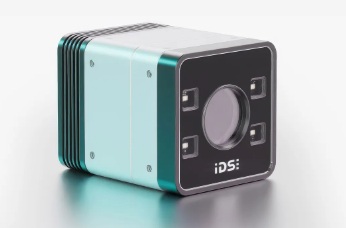
Nion 3D ToF camera – Courtesy IDS Imaging

OnSemi AF0130 Hyperlux ID sensor

The AF0130 belongs to the Hyperlux ID family. It’s an Indirect Time of Flight (iToF) sensor, back side illuminated (BSI) CMOS global shutter depth and imaging solution. It calculates depth, confidence and intensity maps at high speeds from its laser modulated exposures.

Why is IDS Imaging introducing a ToF product

We’ve covered IDS evolving range of stereo vision 3D cameras previously, as recently as a few months ago, in Ensenso 3D for logistics applications.

But while powerful, stereo vision requires at least two cameras, and the corresponding electronics and software to synchronize the images and build the 3D model. So it can be overkill if you don’t need that level of performance.

With the Nion ToF product, IDS brings a more affordable 3D imaging solution to the market, which is more than good enough for many 3D applications .

The video below provides a nice overview. We tease out some of the key points in text and graphics further below, but you might like the dynamics of the video:

What’s inside that IP67 enclosure?

IP67 means dustproof and immersible in water to a depth of 1 meter for up to 30 minutes. That’s pretty robust. More than good enough for even the most challenging industrial environment, outdoor or wash down context.

Besides the tight enclosure, of course there’s a lens to focus the light source onto the sensor, electronics to support the GigE Vision interface, the sensor is the heart of the matter.
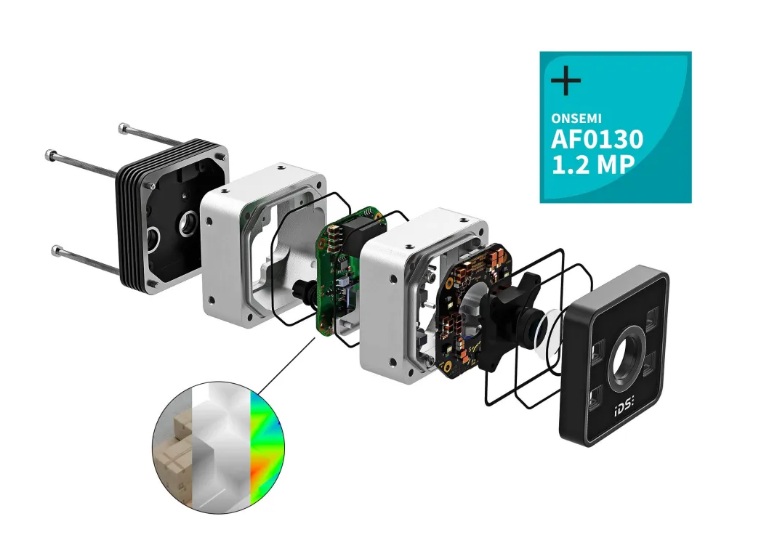
Exploded view of Nion camera – Courtesy IDS Imaging

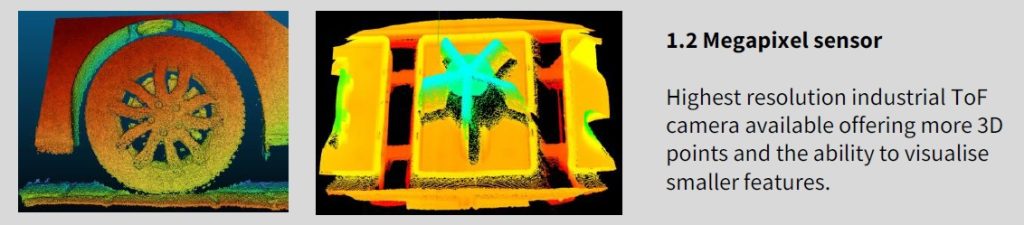
Highest resolution industrial ToF camera

As this blog is released in April 2026, this is the highest resolution industrial ToF camera on the market.
In-sensor readout/storage reduces motion artefacts
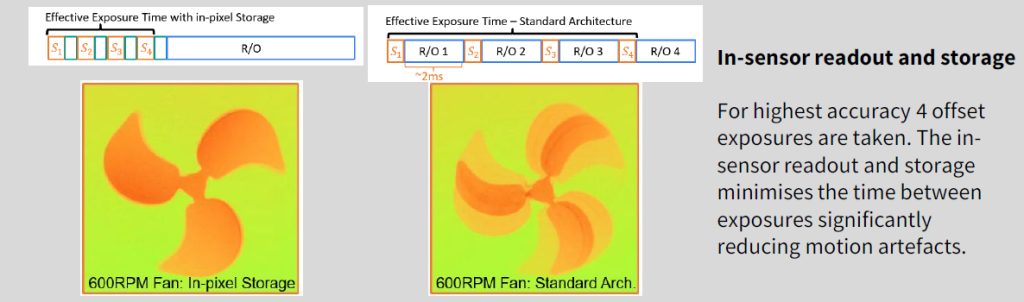
To calculate a single depth value, four coordinated exposures with different phase positions (typically 0°, 90°, 180° and 270°) are usually necessary. These four signals are then used to calculate the phase shift – and thus the distance. Thanks to its special pixel architecture and integrated on-chip processing, the AF0130 iToF sensor captures all four phase images in quick succession and stores them directly and completely in the chip’s memory – without any intermediate readout.

This significantly shortens the time between exposures and noticeably reduces motion blur. Another advantage of continuous reading: The depth information can be efficiently re-sorted and directly processed further – without time-consuming post-processing. This not only makes the camera more robust against movement, but also enables higher frame rates and reduces the load on the host system. This is a decisive advantage, particularly in dynamic applications such as robotics, logistics or pick-and-place.
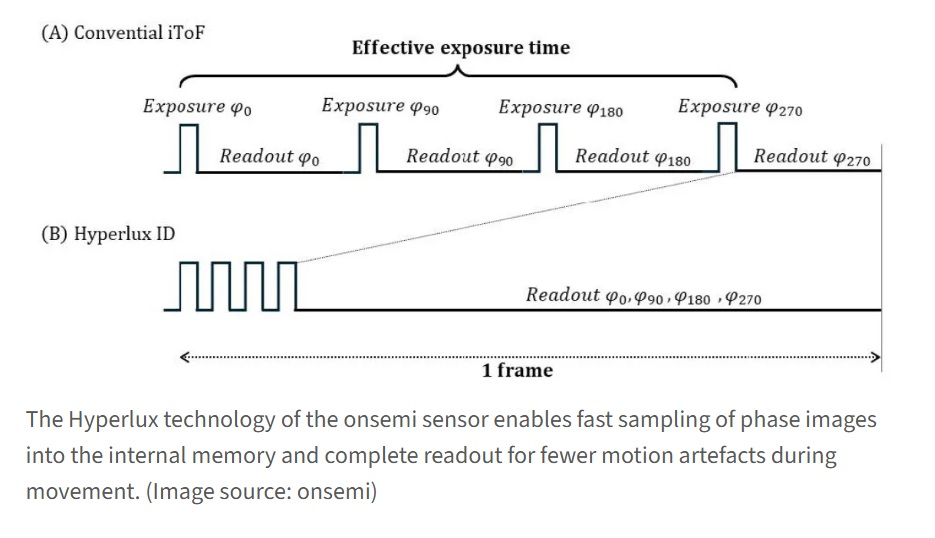
Hyperlux technology by onsemi reduces motion artefacts
Courttesy IDS Imaging

Key takeaways on motion artefact reduction are:

Boiling the above section down to key takeaways, we note:

  1. Multi-phase demodulation (four, to be specific)
  2. Reduced motion artefacts in dynamic scences

Suggested Markets

Just to whet the appetite, we call out logistics, robotics, medical, and manufacturing as sectors where affordable ToF 3D imaging can deliver value on investment. But of course you may have 3D applications in mind in another sector.
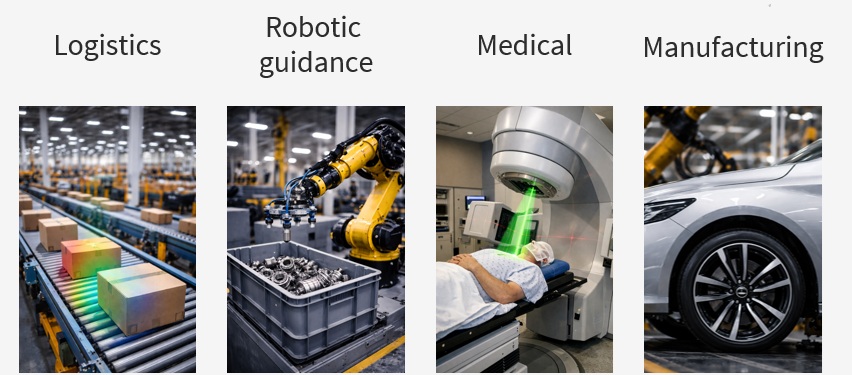

Courtesy IDS Imaging

1st Vision’s sales engineers have over 100 years of combined experience to assist in your camera and components selection.  With a large portfolio of cameraslensescablesNIC cards and industrial computers, we can provide a full vision solution!

About you: We want to hear from you!  We’ve built our brand on our know-how and like to educate the marketplace on imaging technology topics…  What would you like to hear about?… Drop a line to info@1stvision.com with what topics you’d like to know more about.

#3D

#Nion

#ToF

#timeofflight

#IDSImaging
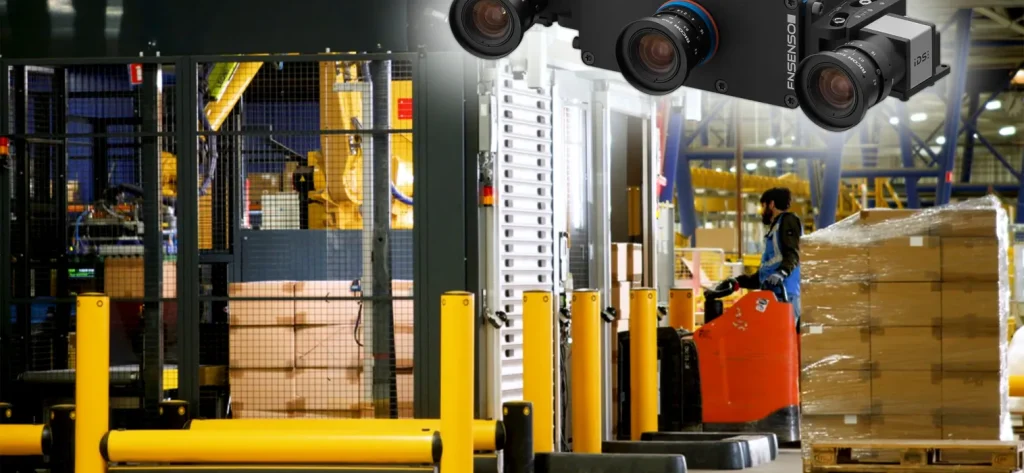
Ensenso 3D for logistics applications

Previously we’ve written about Ensenso series members, like the B-Series for closeup, the C-Series for color, or the whole Ensenso family (B, C, N, S, X, and XR). Or you may have read 3D scanning overviews. 3D applications are myriad, from medicine, industrial, robotics, and more.

Whether you are new to applying imaging to logistics, or looking to upgrade current systems, 3D machine vision continues to drive innovation and opportunities.

Materials handling in a warehouse – Courtesy IDS Imaging
Contact us

In this piece we focus on logistics. Consider:

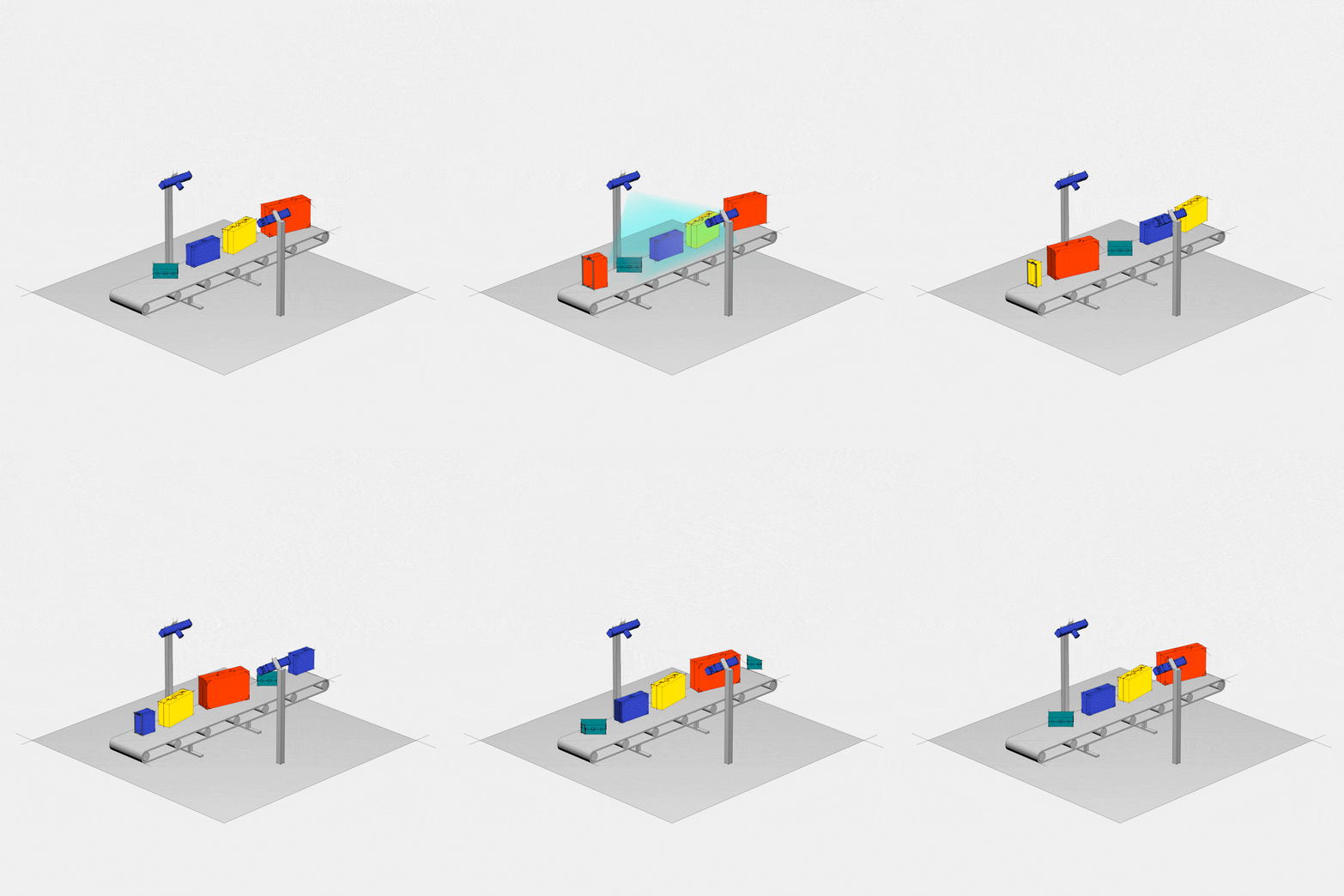
Conveyor object inspection and classificationdepth data enables detection, sorting, and volume measurement
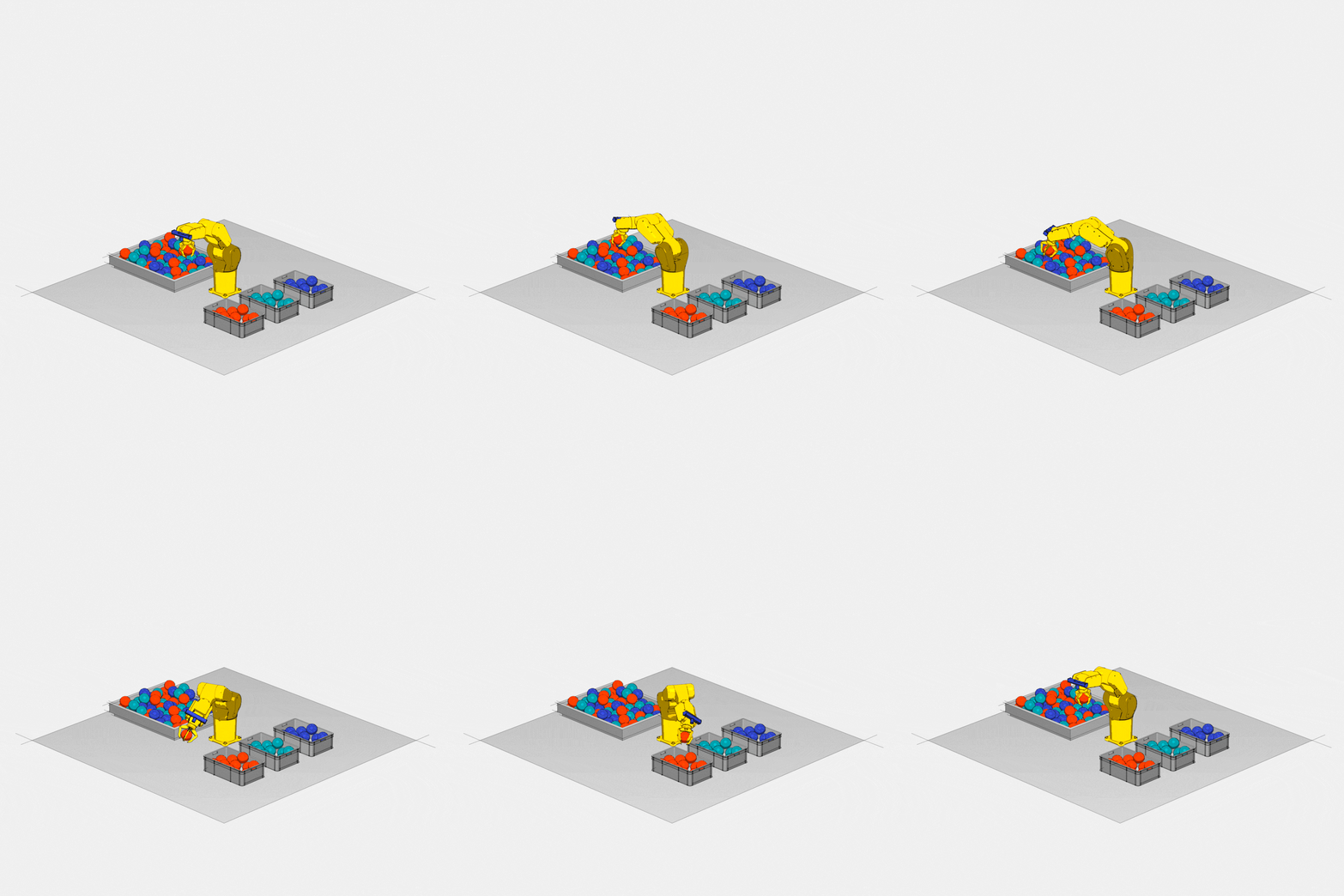
Bin-picking and parts handlingaccurate depth perception helps robots identify and locate items in bulk containers
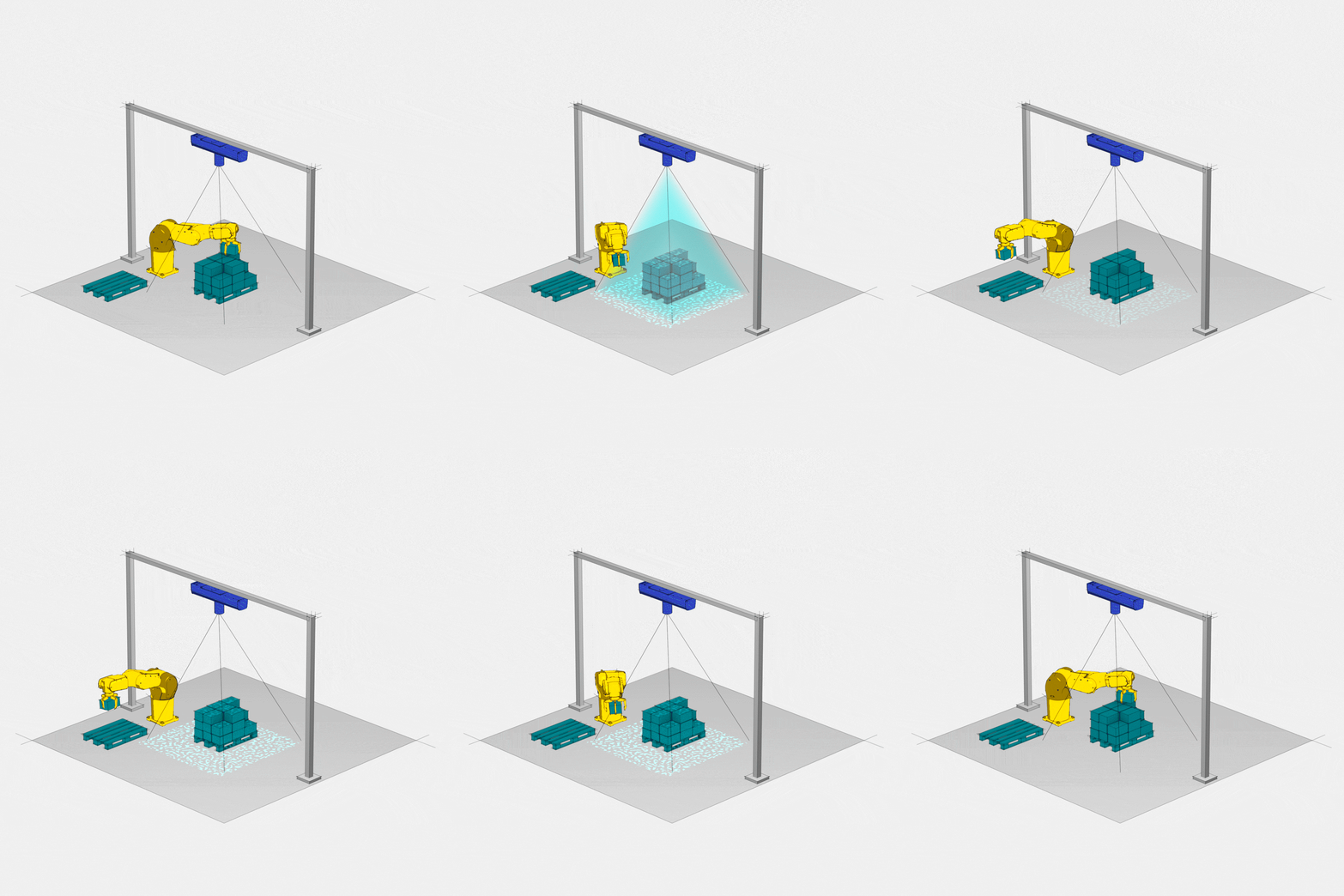
(De-) Palletizing automation3D vision supports robot arms in stacking and unstacking pallets
Loading / Unloading trucks3D object localization improves automation
Some popular logistics tasks supported by 3D imaging

Application areas

  • Detect and recognize
  • Bin picking
  • De-palletizing

Detect and recognize

The ability to accurately detect moving objects to select, sort, verify, steer, or count can enhance (or create new) applications. Ensenso C’s high-luminance projector enables high pattern contrast for single-shot images. Video courtesy of IDS Imaging.


Bin picking

Regardless of a robot’s gripping sensitivity, speed, and range of motion, 3D imaging accuracy is central to success. Ensenso C’s integrated RGB sensor can make all the difference for color-dependent applications. Video courtesy of IDS Imaging.


De-palletize

De-palletizing might seem like a straightforward operation, but must detect object size, rotation and position even with different and densely stacked goods. Ensenso supports all those requirements – even from a distance. Video courtesy of IDS Imaging.


How does stereo imaging work?

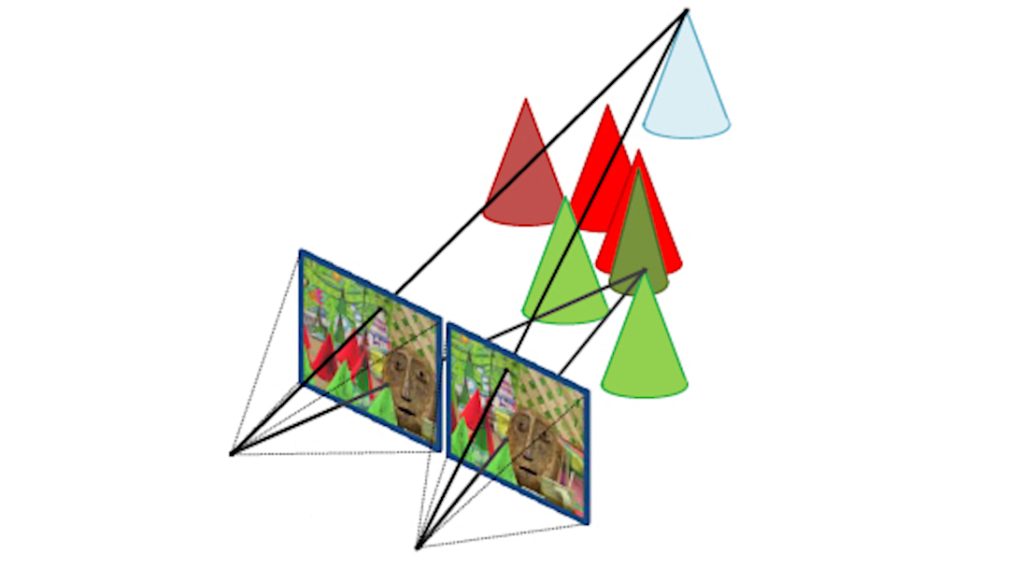
Two-eyed humans and other animals, as well as two-camera stereo systems, use triangulation to achieve depth perception. If a given point on an object’s surface is offset more from one sensor than another, the collection of all such measurements can be used to create a point cloud model of the 3D scene.

Note the differential offsets for the projection beams of two cones – Courtesy IDS Imaging

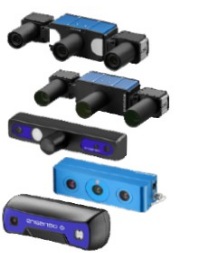
You’ve got options – multiple stereo imaging setups

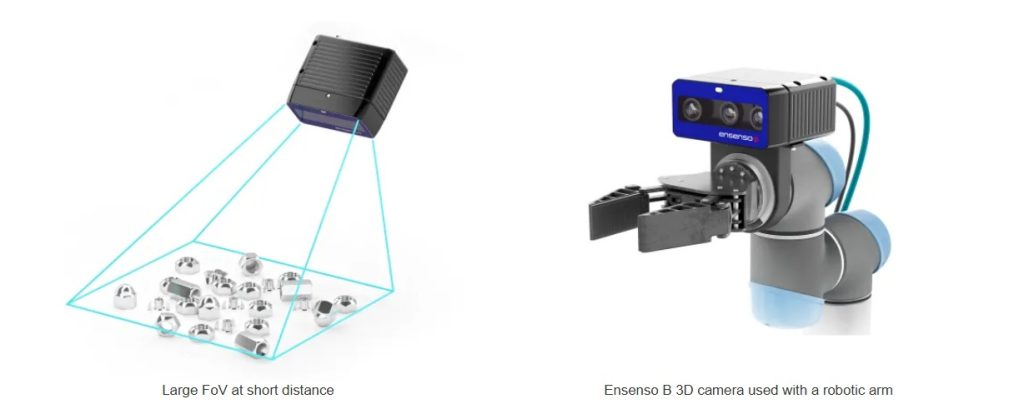
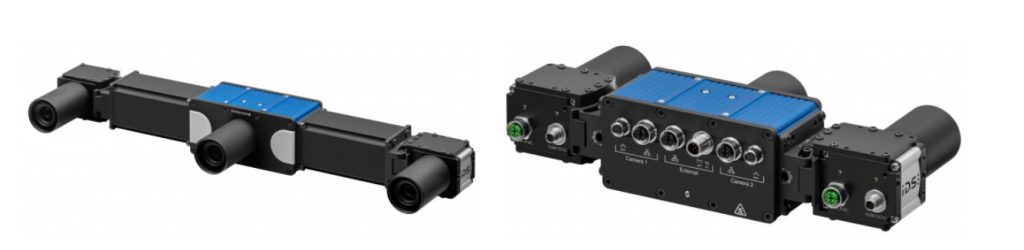
IDS Imaging Ensenso 3D cameras and camera systems are built for industrial 3D imaging with a GigE interface for ease of setup. There are monochrome and color options, as well as hybrid/blended systems. Short-distance capabilities to a few millimeters. Long-distance systems with WD to 5 meters. Modular pre-housed systems. And ruggedized systems for harsh environments.

Ensenso product family – Courtesy IDS Imaging
Short distance applications – Courtesy IDS Imaging
Ensenso XR with working distance to 5m – Courtesy IDS Imaging

Want some help with your logistics systems planning?

Call us at 978-474-0044. Our sales engineers come from diverse machine vision backgrounds, and we stake our reputation on helping clients select the best components and systems.

1st Vision’s sales engineers have over 100 years of combined experience to assist in your camera and components selection.  With a large portfolio of cameraslensescablesNIC cards and industrial computers, we can provide a full vision solution!

About you: We want to hear from you!  We’ve built our brand on our know-how and like to educate the marketplace on imaging technology topics…  What would you like to hear about?… Drop a line to info@1stvision.com with what topics you’d like to know more about.

Z-Trak Express 5k profiles per second

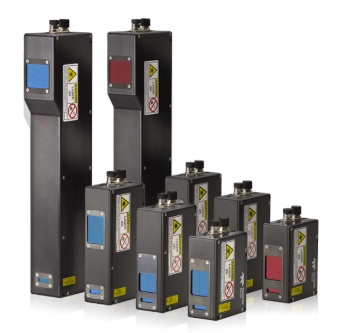
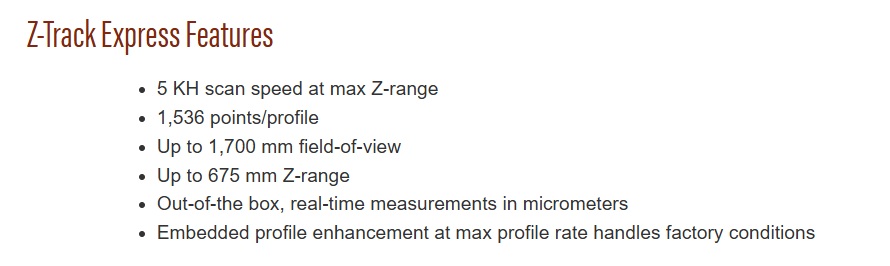
For 3D in-line measurement and inspection applications across various industries such as battery, automotive, lumber inspection, factory automation, logistics, and more. Constant profile rate of 5,000 profiles per second, along with real-time processing. Cost-effective, eye-safe red or blue lasers. Up to 1,700 mm field-of-view. Up to 675 mm Z-range.

Z-Trak Express laser line profiler series
– Courtesy Teledyne DALSA

Newest series in large Z-Trak product line

Teledyne DALSA now offers four distinct 3D laser profiler series in its Z-Trak product line. Each member of the four series is a compact high-performance 3D laser profiler sensor. Each delivers high resolution height measurements using laser triangulation techniques. Each 3D profiler is factory calibrated to ensure accurate, consistent results.

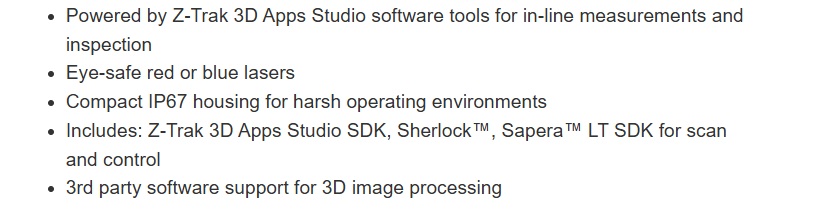
IP67 protection for harsh environments

And each is built with IP67 protection to withstand the demands of harsh industrial environments making them suitable for industrial applications such as factory automation, metrology, surface, semiconductor, and parts inspection.

contact us

Z-Trak Express in particular

Key features – Courtesy Teledyne DALSA
Additional features and capabilities – Courtesy Teledyne DALSA

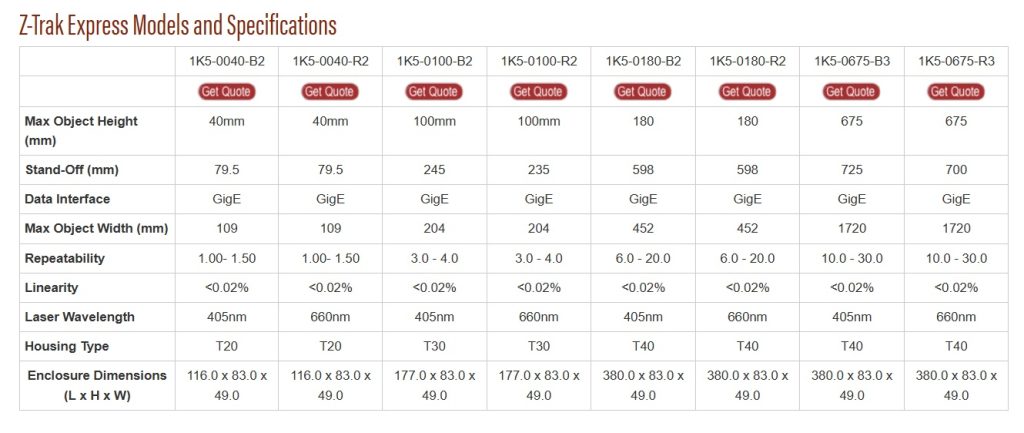
Detailed specs for each member of the series

You can find all the specs in the datasheets. For all Z-Trak laser profilers, see the Z-Trak product family overview. Then drill in on any specific family for more information.

If you know it’s new Express products you want, see Z-Trak Express 3D laser profiler.

Sometimes a single Z-Trak profiler is enough

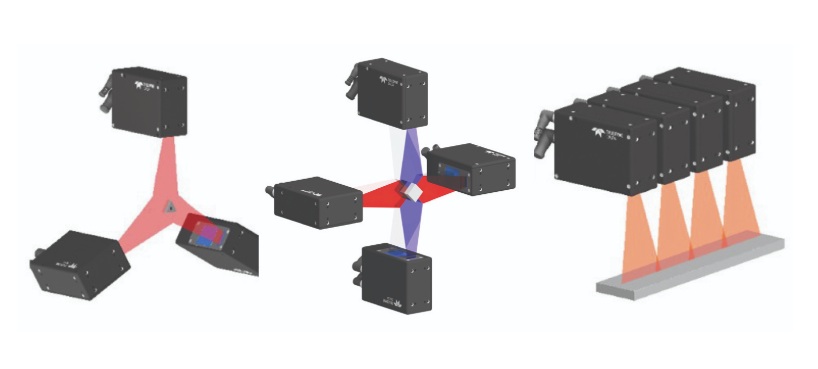
But for some applications one might want to combine two or more sensors, in various spatial configurations:

Combine multiple units according to application requirements – Courtesy Teledyne DALSA

To simplify deployment and reduce costs, the Z-Trak Express 1K5 synchronizes multiple sensors via the data cables and supports content-based triggering for enhanced flexibility.

Which Z-Trak 3D camera is best for my application?

See our blog on key characteristics of 3D laser profiling, as a basis for choosing among Z-Trak 3D cameras. Or let us guide you through it by phone: 978-474-0044. Or use the form below. Together we can do this!

1st Vision’s sales engineers have over 100 years of combined experience to assist in your camera and components selection.  With a large portfolio of cameraslensescablesNIC cards and industrial computers, we can provide a full vision solution!

About you: We want to hear from you!  We’ve built our brand on our know-how and like to educate the marketplace on imaging technology topics…  What would you like to hear about?… Drop a line to info@1stvision.com with what topics you’d like to know more about.

#3D

#profiler

AT Sensors – 3D Families Comparison

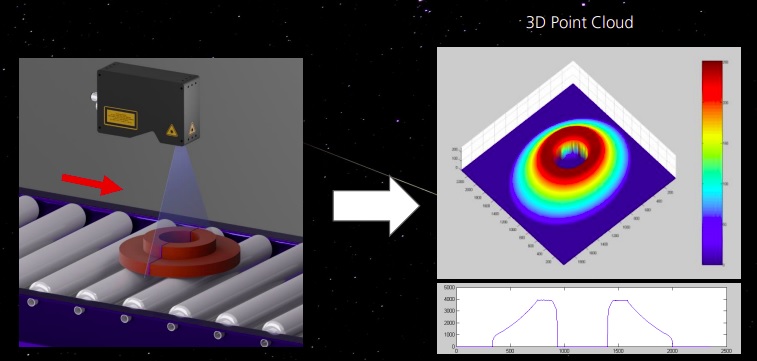
3D point cloud

Preamble on 3D options

If you aren’t yet doing 3D imaging – but wonder if you should consider it – consider our TechBrief: Which Type of 3D imaging is best for my application? 3D machine vision provides contactless measurement. Learn the key approaches and their capabilities, constraints, and comparative costs.

Types of 3D imagining covered in the TechBrief linked above include:

  • Triangulation
  • Structured light
  • Time of Flight (ToF), and
  • Stereo vision

Since triangulation is fast, accurate, and affordable – for a wide range of applications to which it’s ideally suited, let’s presume for the rest of this blog you are pursuing that approach.

3D point cloud
From real space to 3D point cloud model – Image courtesy of AT Sensors

AT Sensor families

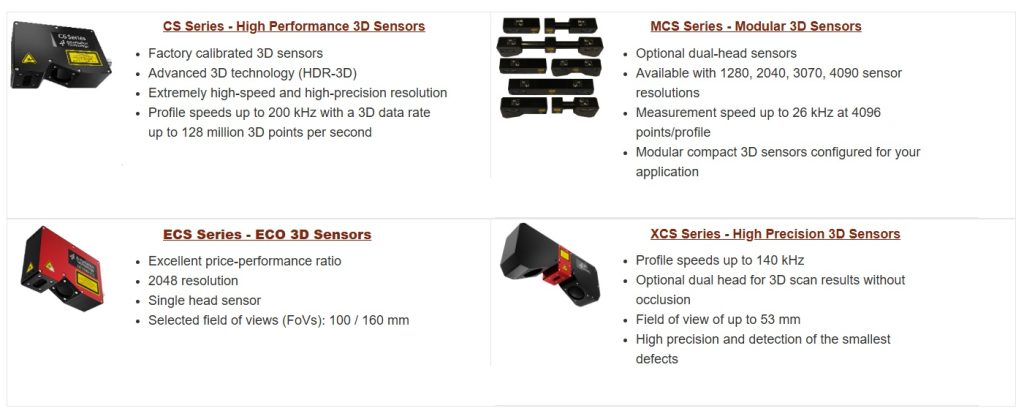
AT Sensors 3D laser profilers feature cutting-edge 3D laser sensors with high-speed and high-precision resolution with IP54 or IP67 protection for industrial environments. AT Sensors’s 3D laser profilers are factory calibrated with profile speeds up to 200 kHz, and profile resolutions up to 4096 points/profile. All AT Sensors 3D sensors laser profilers support the latest GigE Vision/GenICam 3D standard.

AT Sensors’ families – click to go to product pages

The AT Sensors’ series of 3D sensors include high performance CS 3D sensors, modular MCS 3D sensors, high precision XCS 3D sensors, and ECS 3D sensors with an excellent price-performance ratio. These innovative 3D sensors are suitable for numerous industries such as, inspection, automotive, infrastructure, and food and beverage.

Instructive short video featuring XCS dual-head inspection of Pin Grid Arrays (PGA) – Courtesy AT Sensors

How to choose?

If you’d like a very high level overview of the 4 AT Sensors 3D product families, consider:

AT Sensors 3D product families – a simplistic but helpful differentiation

*Internal values. The actual usable profile speed may be limited by the 1 Gbit/s interface.

Click to contact
Give us some brief idea of your application and we will contact you to discuss 3D options.

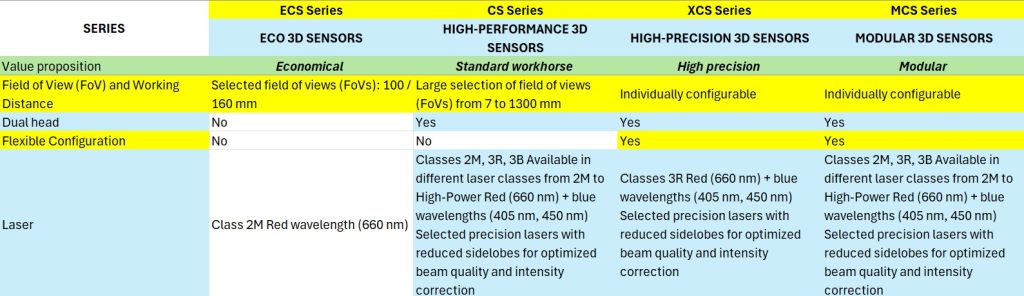
Field of View and Flexible configuration options:

AT Sensors 3D families: differentiated FoV, sensor count, configurability, and laser options

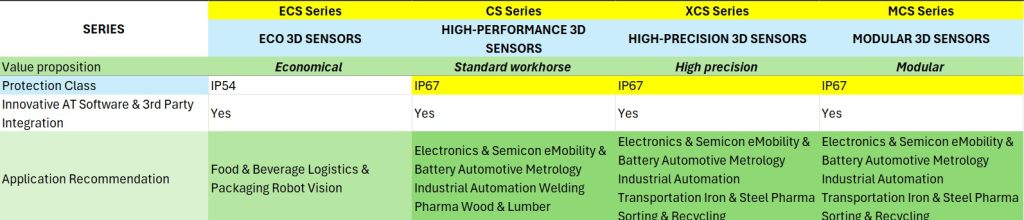
IP protection class and suggested applications

AT Sensors 3D families: IP protection class, software coverage, and suggested applications

How to choose? (in summary)

As you can see above, or by chasing the product detail pages, AT Sensors has a wide offering of 3D laser triangulation scanners, each of which builds a point cloud model of your targets. With four product families, and member breakouts within the families, there’s likely a model that meets your need for speed, resolution, IP class, and configurability.

At the risk of oversimplifying the AT Sensors 3D families:

ECS Series: Economical – fewer features but if it does the job low cost sounds nice

CS Series: Standard workhorse – high performance with several models available

XCS Series: High precision – think eXtra with the X – optional dual head sensors

MCS Series: Modular – also high performance but custom configurable too

Let us help you find the best fit!

1st Vision’s sales engineers have over 100 years of combined experience to assist in your camera and components selection.  With a large portfolio of cameraslensescablesNIC cards and industrial computers, we can provide a full vision solution!

About you: We want to hear from you!  We’ve built our brand on our know-how and like to educate the marketplace on imaging technology topics…  What would you like to hear about?… Drop a line to info@1stvision.com with what topics you’d like to know more about.