Multispectral imaging, in general terms, creates solutions that draw on spectral response from two or more regions of the electromagnetic spectrum. So it might be UV+VIS or VIS+IR, for example. And VIS might be monochrome (with or without filters) or color. And IR might be any of NIR, SWIR, MWIR, or LWIR. If you can add value and competitive advantage through an application built on a multispectral approach, there are cameras, sensors, lenses, filters, and lighting to support your design.
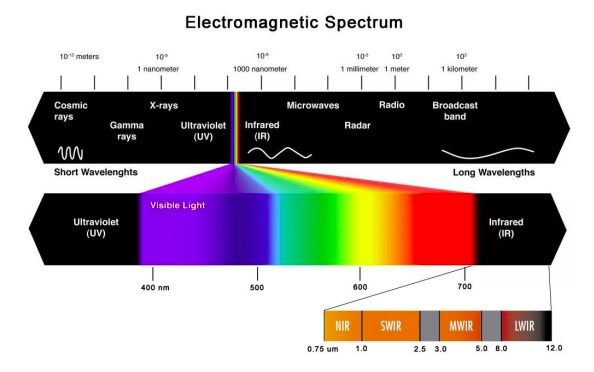
Traditionally one would need two different cameras to create a multispectral solution. That’s because most cameras are designed around a sensor that is optimized for just one portion of the spectrum. While there are good reasons behind cameras that “specialize” on just a segment of the spectrum, it creates multi-camera integration challenges for those who want to build multispectral solutions. Until now…
RGB / NIR with DALSA Linea ML-FC-08K07N
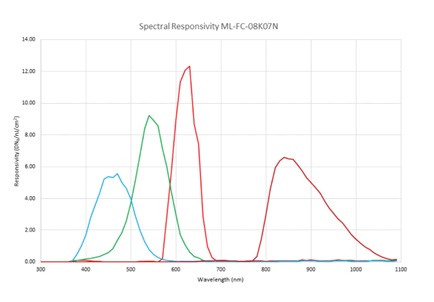
Take a look at the response curve below. The 8K DALSA proprietary CMOS sensor used in the Linea ML-FC-08K07N camera performs well on both sides of 700 nm. To the left it’s responsive in the VIS portion of the spectrum, from 400 – 700 nm. And to the right it does well in NIR, from 800 – 1000 nm. That’s an unusual and powerful range.
Applications potential
Banknote and secure documents inspection: The visible inspection handles geometric feature checks, while NIR looks for special inks that appear only in those wavelengths.
Semiconductor wafer and PCB inspection: Find defects below the surface with NIR. While doing surface inspection in VIS.

Multisource imaging
Suppose you need to capture both brightfield and darkfield images of the same linescan continuous target. While one could set up two different cameras, calculate offset timing based on motion characteristics, and integrate or compare images on the host…
… with multiple strobed light sources… and the DALSA ML 8K camera sensitive to both VIS and NIR, the same camera can capture both brightfield and darkfield images in a single pass.
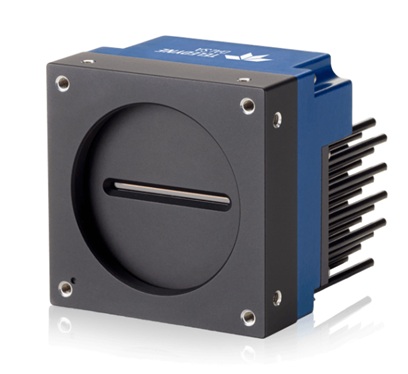
Key features include:
8,192×4 multiline trilinear color & NIR CMOS line scan sensor
Camera Link HS Fiber interface*
75kHz scan rate
72dB dynamic range
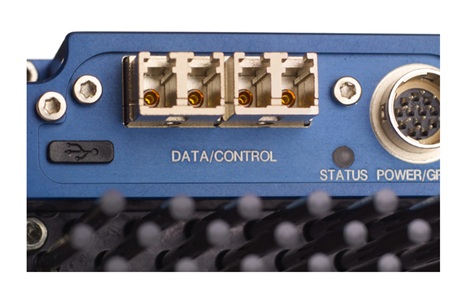
(*) Linea ML is DALSA’s first camera with native fiber optic connectors. No adapters or converters required. Fiber has two key advantages: (1) long cable runs beyond copper cable performance; (2) immunity to electrical interference
Line scan and multispectral imaging are both a bit more obscure than area scan machine vision. But each incredibly powerful, either alone or in combination. We’d be delighted to understand your application goals and constraints, to help you determine solution options.

1st Vision’s sales engineers have over 100 years of combined experience to assist in your camera and components selection. With a large portfolio of cameras, lenses, cables, NIC cards and industrial computers, we can provide a full vision solution!
About you: We want to hear from you! We’ve built our brand on our know-how and like to educate the marketplace on imaging technology topics… What would you like to hear about?… Drop a line to info@1stvision.com with what topics you’d like to know more about.
#Multispectral
#LineaML