Remote Direct Memory Access – RDMA – is a data transfer method supporting greater throughput compared to traditional transfer methods. While it’s been used in data centers and by networking innovators for some years, it’s only recently been made available for machine vision.
In a phrase: RDMA is a method of transferring data directly between a device and a designated area of computer memory with little involvement from the operating system and CPU.
Some image transfer context to motivate the need for RDMA
Cameras doing real time machine vision don’t send entire images in a single file – it’s not like jpg images from a smartphone. Rather, sensor data is read out in pixel values conveyed in bytes in turn assembled into packets. The operating system, CPU, and networking protocol move the packets and assemble the image in the PC host.
At “conventional” GigE speeds like 1GigE, 5GigE, and 10GigE, a regular NIC and your PC host processor can typically keep up with the framerates flowing from the camera to the PC and vision application software.
But at 25GigE and especially 100GigE, which you may need for your high framerate application, the CPU might get so overwhelmed with data copy and network protocol management that not enough CPU cycles remain for image processing per se. Which in turn risks frame loss and latency bottlenecks.
An analogy
Suppose a package has to get to a specific recipient’s desk in a mid-town office building or on a large industrial campus with multiple buildings and departments. One method would be to get it from the external shipper to a receiving department. Who then transport it to the department level. Who then get it to the business unit. And finally to the intended individual. It works. But it’s a lot of handling, each of which has a cost in labor and time and hence efficiency. That’s equivalent to the traditional network packetization and delivery approach.
The RDMA-equivalent approach would be to authorize the external delivery service (once suitably credentialed) to deliver the parcel directly to the intended desktop, without all the intermediate handling steps.
RDMA at a glance
Recall that GigE Vision utilizes GVSP – GigE Vision Streaming Protocol. Which in turn depends on UDP – User Datagram Protocol. Which is built on top of network layer IP – Internet Protocol. GigE Vision 3.0 added an RDMA-based streaming option, GVRSP, for applications that need higher data rates and less CPU overhead.
Translating that into conventional GigE data transfer, there are typically the four layers shown in the left-hand side of the diagram below: Application, Socket, Transfer Protocol, and Driver level. All those are abstracted away from the user/programmer by your GigE Vision compliant camera, NIC, and SDK – but the layers are all in there. And the successive handoffs between the layers, at both the transmission and receiving side, require communications handoffs and data buffering. Which incurs performance costs in time as well as processor load.
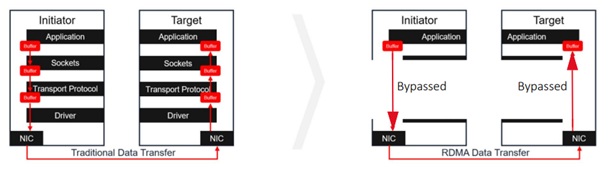
Reduced buffering and handoffs with RDMA
Now look at the right-hand side of the diagram above, utilizing RDMA. Three handoff and two buffering layers are bypassed, yielding substantial throughput gains. Just as with traditional GigE Vision, the user/programmer does not have to manage data transport. Your device manufacturers and SDK provider take of that for you. But you get to harvest the performance gains.
Zero-copy
As you get into RDMA, you may see the “zero-copy” characteristic touted as a benefit. Don’t be confused by the term “copy”. It doesn’t mean conventional networking makes duplicate copies. Merely that conventional networking has to move a packet from one buffer to another, so it copies to the new and releases the old. It’s the “reduced handling instances” concept illustrated in the diagram above.
Key benefits
Higher sustained throughput – host PC doesn’t get bogged down
Lower CPU utilization – frees up capacity for image processing
Lower latency and jitter – image delivery faster and regularized
Improved stability – avoids dropped packets or frames
Putting the pieces together
If your application requires the performance delivered by RDMA, despite being a GigE protocol, one uses fiber cables instead of conventional Cat6 ethernet cables. One must convert between copper and glass fiber transmission modes at both the transmission and receiving ends. Hence the transceivers as shown in the illustration below.


How long a fiber run do you need?
There are transceivers designed for several different throughput and cable length requirements. Costs scale accordingly. But innovative machine vision solutions that bring competitive advantage can drive revenue or reduce other costs, so it’s partly about engineering possibilities and partly about cost : benefit calculation.
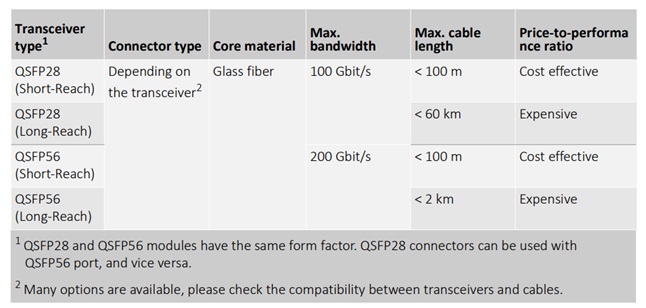
Note: the multi-km cable lengths are a benefit of fiber optics, not of RDMA per se. It’s a happy coincidence that RDMA performance at 25 and 100GigE is best supported by fiber optics; and that once a signal is on fiber, and can be reliably transmitted a long distance.
Do you need 25 or 100 GigE? Fiber optic cables? RDMA? Start with required application outcomes in terms of image characteristics and framerate, and work back to sensor, camera, interface, and techniques. We do that.

1st Vision’s sales engineers have over 100 years of combined experience to assist in your camera and components selection. With a large portfolio of cameras, lenses, cables, NIC cards and industrial computers, we can provide a full vision solution!
About you: We want to hear from you! We’ve built our brand on our know-how and like to educate the marketplace on imaging technology topics… What would you like to hear about?… Drop a line to info@1stvision.com with what topics you’d like to know more about.
#RDMA
#Remotedirectmemoryaccess