Medical and life science imaging applications are doing ever more challenging applications. This is partly due to evolving technology and what that enables. And of course also to applications ingenuity.
These applications continue to push the need for:
- Improved image quality
- Better color accuracy
- Higher sensitivity
- More reliable data for AI and diagnostics
Key takeaway:
Prism-based cameras overcome many of the limitations of traditional Bayer color cameras by capturing true color information without interpolation.
Brief review of Bayer color interpolation
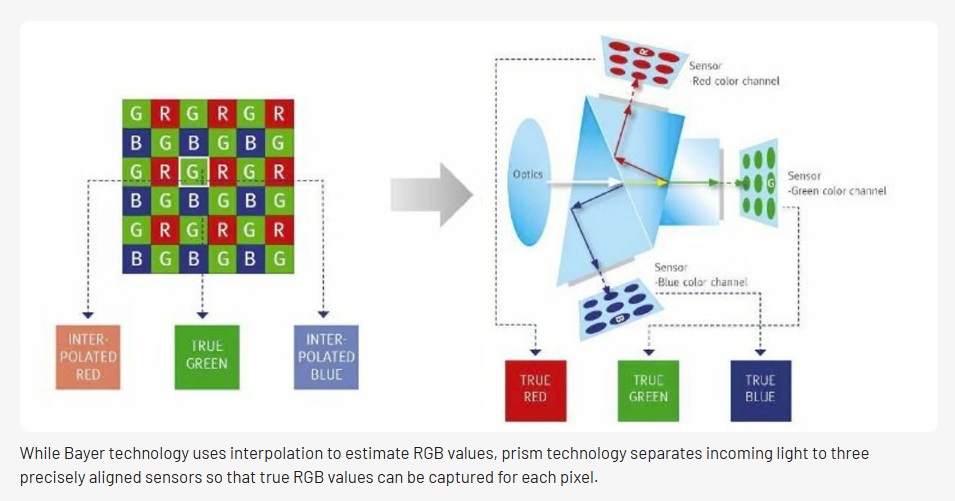
A Bayer filter “color” camera uses a monochrome sensor fitted with a Bayer filter, outputting color image derived through interpolation. Interpolation is a form of approximation – some precision is lost.
Please chase that Wikipedia link above if you want the full tutorial on the Bayer filter approach. It was and remains a very clever and effective technique for color imaging that works effectively for the vast majority of color applications. But not all…
Per the Wikipedia article, downsides of the Bayer approach can include artefacts like Moiré patterns, false color, and/or zippering.
If you are pushing the envelope of precision high-resolution color imaging, to innovate a new application or to stay ahead of your competition, you may want to consider prism-based color cameras, for better color accuracy and improved image quality.
Representative applications that may benefit:
- Digital pathology
- Microscopy
- Cell analysis
- Histology
- Pharmaceutical inspection
- Medical device inspection
How prism cameras work
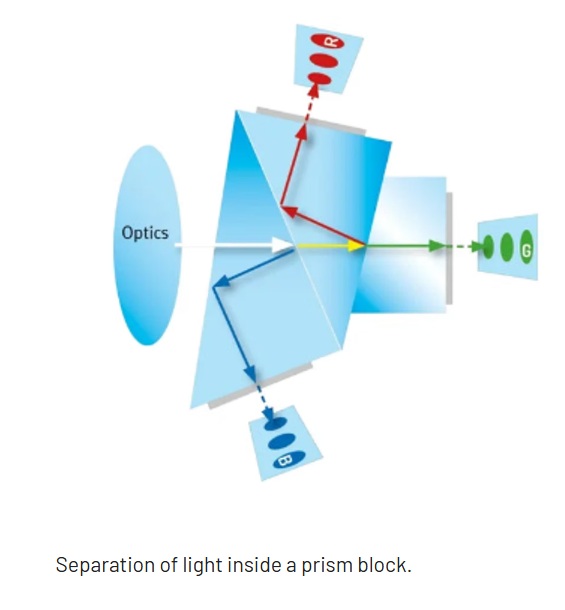
Incoming light passes through a dichroic prism, which splits the light into separate color channels directed onto individual monochrome sensors. The optical path through the lens and up until reaching the prism is identical, to insure pixel alignment.
Benefits:
- True RGB at every pixel (no interpolation)
- Superior color accuracy
- Better spatial resolution
- Improved repeatability
Already intrigued? Prefer to just speak about it? Call us at 978-474-0044 for expert assistance. Or briefly describe your application in the form linked below and request a callback:

What color prism cameras are available?
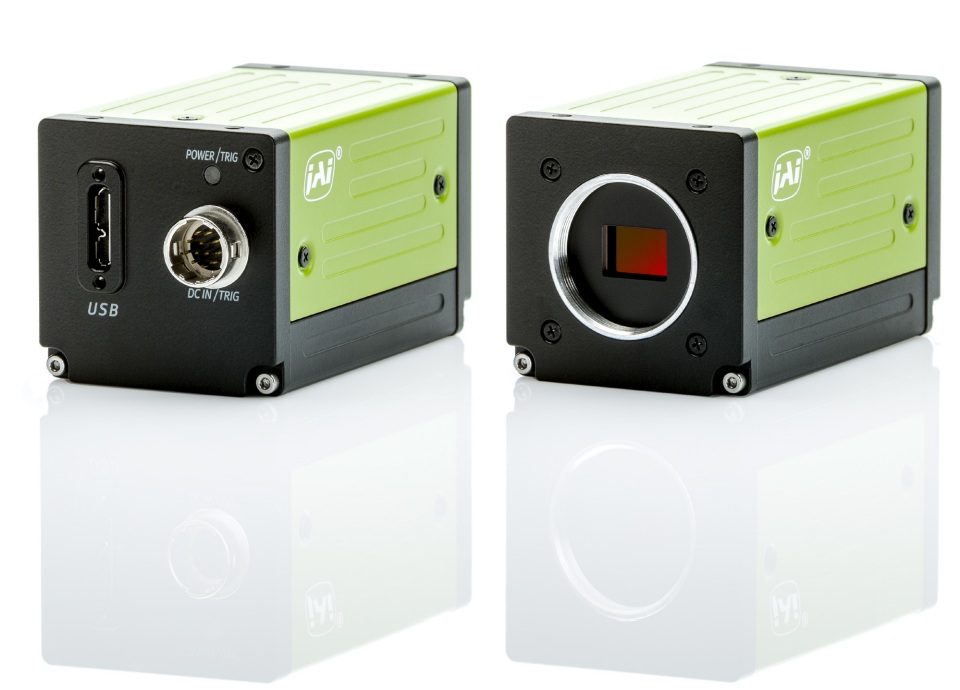
JAI Apex prism-based color cameras are available with interfaces ranging over USB3, GigE, 5GigE, Camera Link, 10GigE, and CoaXpress.
Why Prism Technology Excels in Microscopy
- Better color accuracy
- Differentiation of stains and dyes
- Improved visualization of cellular structures
- Improved quantitative analysis
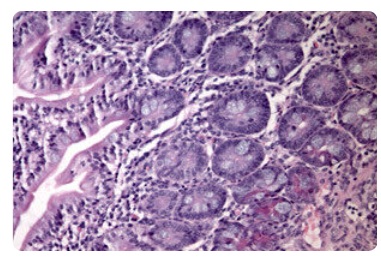
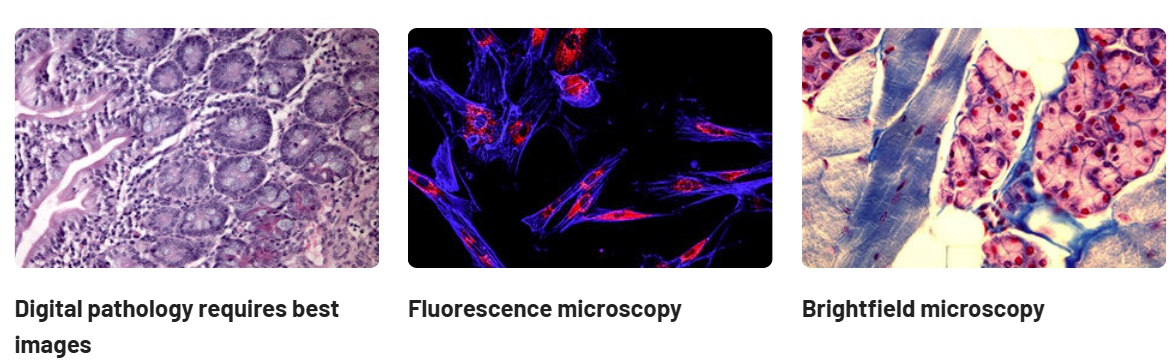
Digital pathology requires precise color images, aiding in the differentiation of stains and dyes; and to visualize structures.
Courtesy JAI.
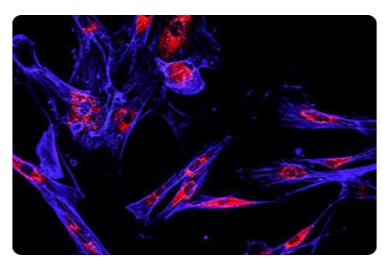
Fluorescence microscopy helps make specific proteins and compounds observable. Prism cameras ensure even subtle changes are identifiable.
Courtesy JAI.
Surgical Imaging and NIR Fluorescence
Now let’s take it up a level. While not restricted to surgical navigation, either robotic or conventional, it’s clear that real-time surgical navigation is mission critical. Tissue differentiation is essential.
Consider the benefits of not just precision color, as discussed above, but the added benefit of NIR, from the same optical path and at the same position. A four-sensor prism-based camera can do exactly that. So the surgeon (whether human or robotic) may compare a color image to an NIR image in the same orientation and moment, to achieve tissue differentiation.
By virtue of using both VIS and NIR portions of the spectrum, such a camera is considered multi-spectral.
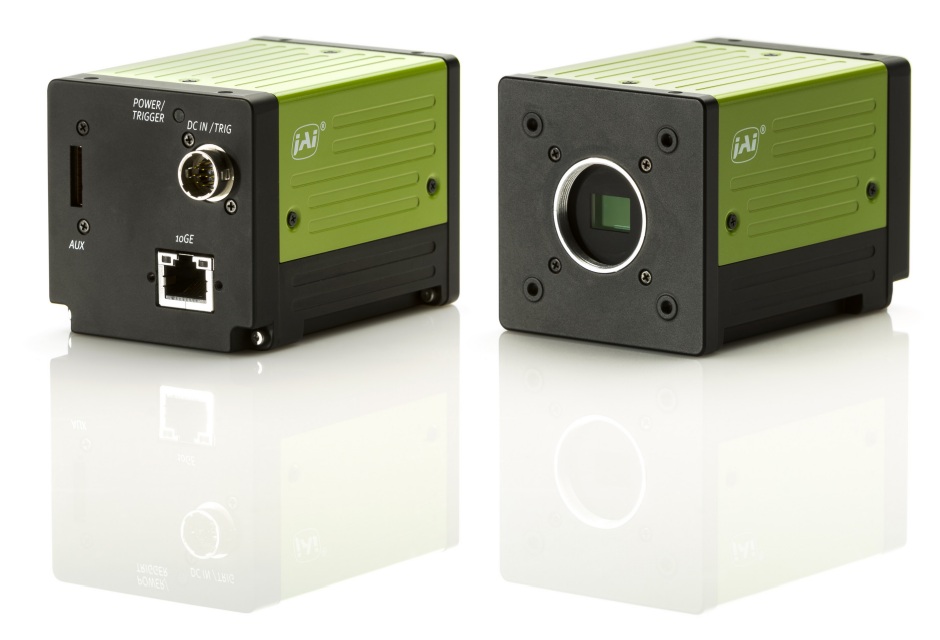
Consider the JAI Fusion family of prism cameras, utilizing GigE and 10GigE interfaces to deliver high frame rate multispectral images with RGB and NIR.
Multispectral applications
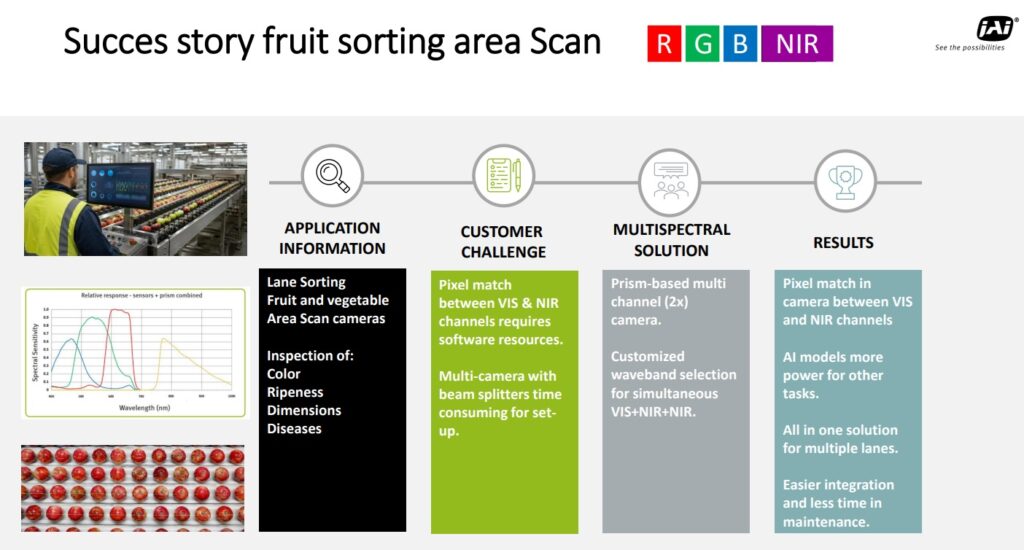
Below we see that a 4 sensor camera (R, G, B, and NIR) permits a single camera to deliver pixel level information across multiple spectra, without requiring pixel-matching in software. This example happens to be in fruit sorting.
Another food sorting example:
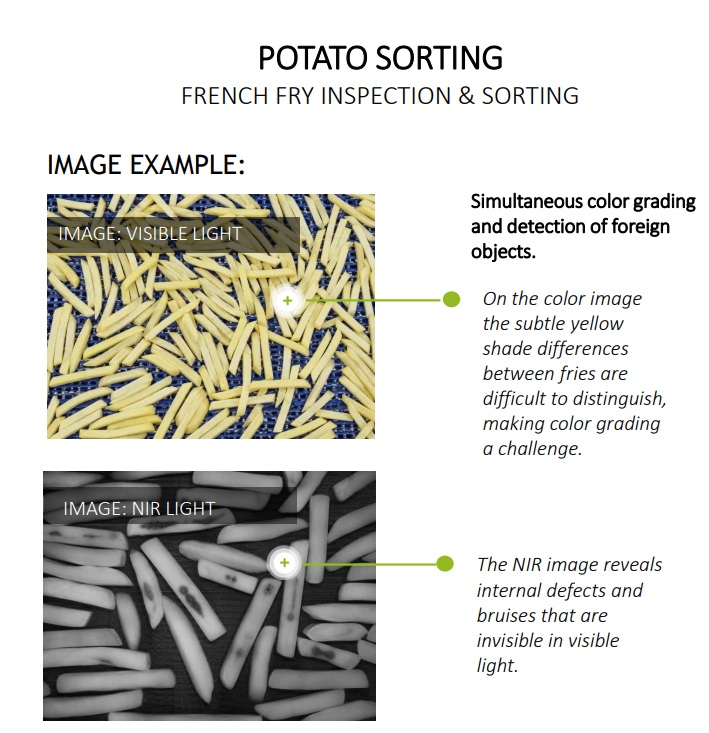
In the potato sorting application below, visible light may be helpful for some aspects of inspection, but NIR identifies defects that VIS doesn’t see. A prism-based multispectral camera adds clear value.
1stVision’s Knowledge Base has TechBriefs on camera and sensor selection, lighting, filters, optics, and so forth. And we’re always happy to advise by phone 978-474-0044 or via our inquiry form.

1st Vision’s sales engineers have over 100 years of combined experience to assist in your camera and components selection. With a large portfolio of cameras, lenses, cables, NIC cards and industrial computers, we can provide a full vision solution!
About you: We want to hear from you! We’ve built our brand on our know-how and like to educate the marketplace on imaging technology topics… What would you like to hear about?… Drop a line to info@1stvision.com with what topics you’d like to know more about.
#prismcamera
#medicalimagingcamera
#JAI