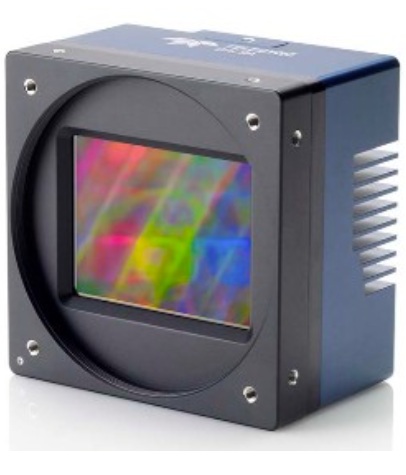
Note: Below we introduce both the Scientific and High-speed versions of the Falcon4 67MP cameras. They are both based on the same sensor, and offer many of the same features. But one is optimized for speed (90 fps), and the other for scientific applications (65 fps) – still impressively fast.
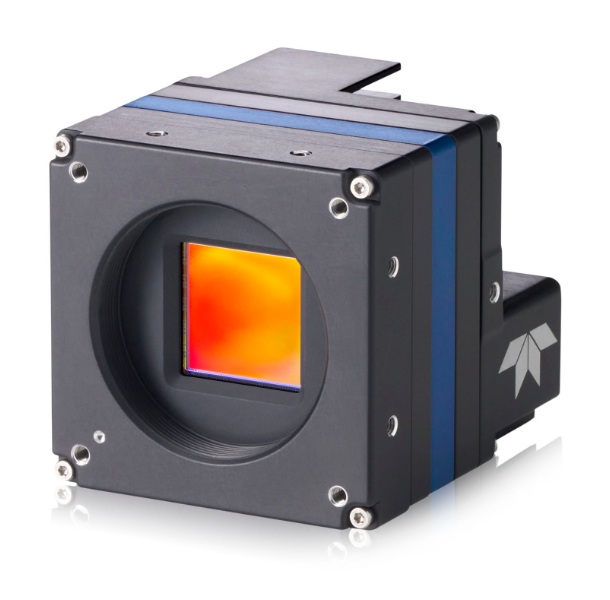
The Teledyne Falcon4 67.1 MP monochrome area scan cameras designed for demanding applications. One version is optimized for scientific and quantitative imaging applications; the other for high-speed. The camera features 8192 × 8192 resolution with 2.5 µm pixels. Square large-format APS-C sensor and Camera Link HS (CLHS) interface.
Image courtesy Teledyne DALSA.
Let’s compare these sister cameras side-by-side:
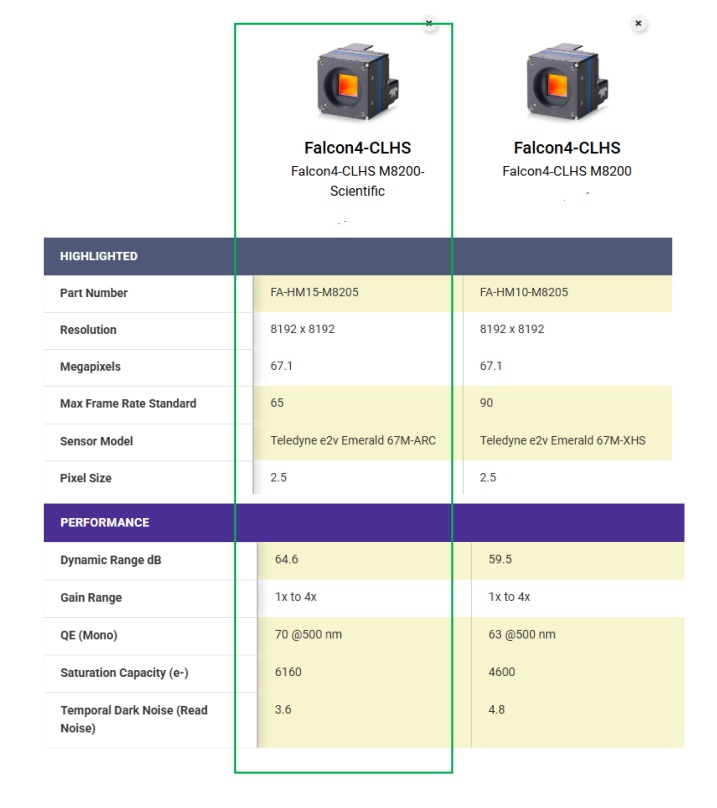
A few notes about the side-by-side comparison above:
- Teledyne DALSA developed the high-speed version first, the Falcon4-CLHS M8200. Per our TechBrief Machine Vision Sensor Attributes Explained, the high-speed version of the camera is already a high performer.
- But certain applications, especially in the life-sciences, demand even higher performance in terms of dynamic range, quantum efficiency, and the lowest possible noise. So Teledyne DALSA spun off the scientific version of the camera, with alternative firmware, added antireflective sensor coating, and reduced the clock rate, now offering the Falcon4-CLHS M8200 Scientific model.
Scientific imaging isn’t only about getting a good-looking image For quantitative imaging, the camera is being used as a measurement instrument, not simply to identify an object. The Falcon4-CLHS M8200-Scientific provides pixel-level factory calibration, in addition to its low read noise, higher quantum efficiency and wide dynamic range. These characteristics are intended to support applications where image consistency and measurement accuracy are critical.

Why a square 8K x 8K sensor?
The square sensor format maximizes usable imaging area for microscopy applications. With a 2.5um square pixel, that’s how they got to a 67MP sensor in a compact area. Yes, that puts demands on optics, but a lenses with good MTF performance. Lens quality and specifications vary – we can help you find a great lens for these cameras and your application requirements.
Applications areas include:
Whole-slide imaging, genomics, and spatial omics, fluorescence microscopy, high-content screening, automated cell analysis, imaging cytometry, and light-sheet microscopy.
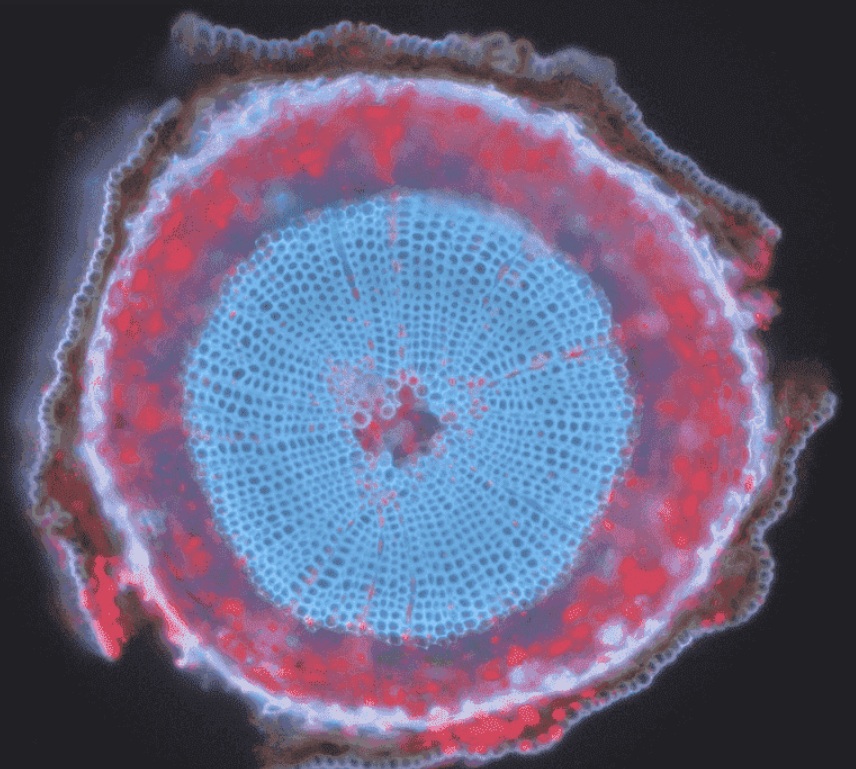
The camera’s combination of low noise, high sensitivity, wide dynamic range, and factory-calibrated image quality also makes it well suited for precision metrology, materials analysis, semiconductor inspection, and other applications where accuracy, throughput, and image consistency are critical.

1st Vision’s sales engineers have over 100 years of combined experience to assist in your camera and components selection. With a large portfolio of cameras, lenses, cables, NIC cards and industrial computers, we can provide a full vision solution!
About you: We want to hear from you! We’ve built our brand on our know-how and like to educate the marketplace on imaging technology topics… What would you like to hear about?… Drop a line to info@1stvision.com with what topics you’d like to know more about.
#DALSAFalconFA-HMM8205
#scientificimaging
#highspeedcamera