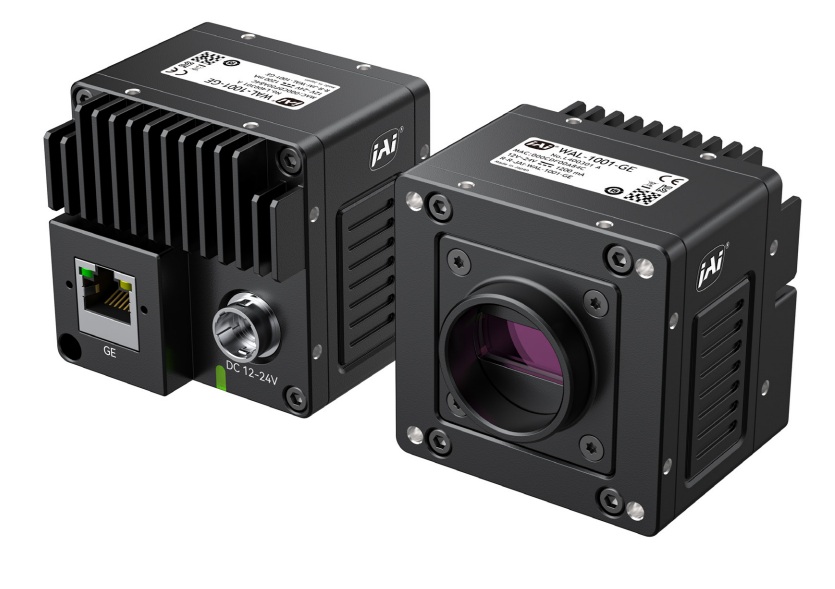
The JAI WAL-1001-GE and -2001- are compact GigE 1K SWIR line scan cameras with InGaAs sensors designed for high-speed industrial inspection using a high-sensitivity InGaAs sensor. While there are a number of area scan SWIR cameras on the market, line scan SWIR is a smaller niche. But if it gives you a competitive edge or innovative solution – it’s not a niche for you.
Optional review on SWIR and line scan
Just in case you’re coming at this from a VIS (visible spectrum) and/or area scan context…
SWIR – Short Wave Infra Red – uses a segment of the spectrum not visible to the human eye nor CMOS sensors used for VIS imaging. But SWIR is very effective at “seeing” things not revealed in VIS. For more on SWIR see our blog and/or knowledge-based article.
Line scan – unlike area scan images that capture a large 2D view and whose framerates are limited by data volumes, line scan sensors are just one or two pixels wide while hundreds or thousands of pixels long.
Two example applications before camera details
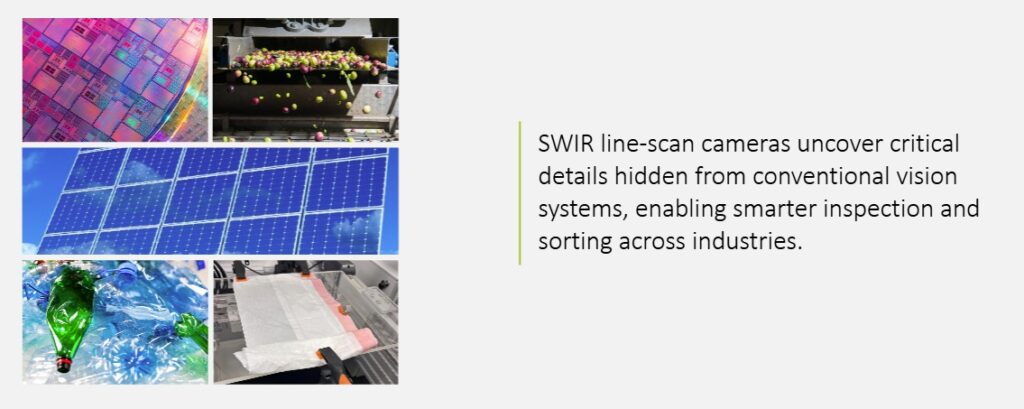
Here are two representative SWIR line scan applications. There are many others as well.
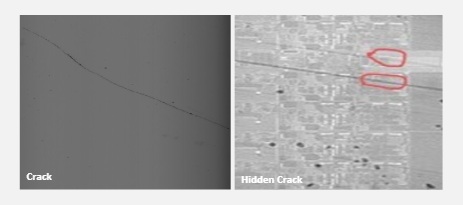
Semiconductor inspection: Detect flawed wafers early in production to avoid shipping flawed product, to reduce production costs, and and increase yield.
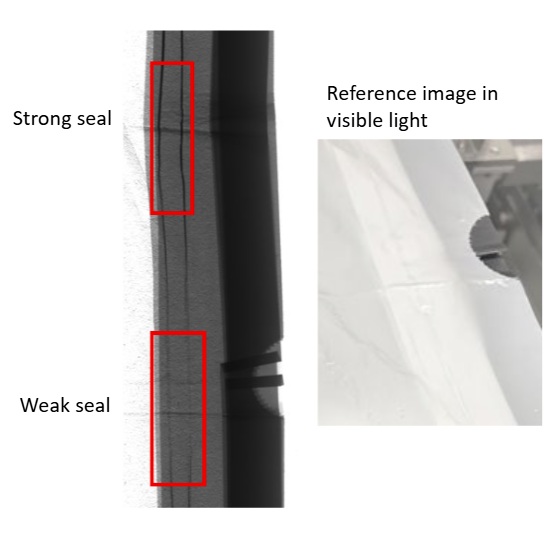
Plastic seal inspection: SWIR imaging reveals contrasts that are not visible with standard visible-light imaging. In this example, the heat seals in a plastic bag needed to be inspected to ensure that the seal was strong and consistent. The bags are produced in a continuous production process, where a single line-scan camera can capture the seams as the product moves through the system.
JAI WAVE WAL 1001 GE and -2001- camera highlights
For full details, including data sheets, tabular overview, etc., see both the SWIR line scan and area scan JAI WAVE cameras at our website. Here we call out just a few highlights.
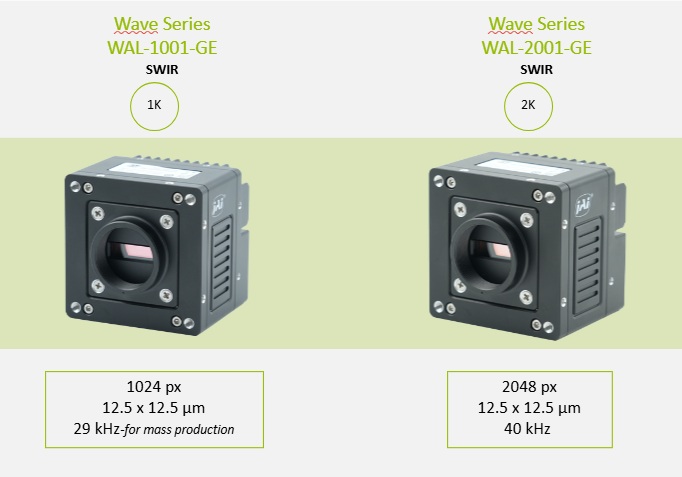
1024 px at 29 kHz or 2048 px at 40 kHz:
(WAL-1001-GE and WAL-2001-GE, respectively)
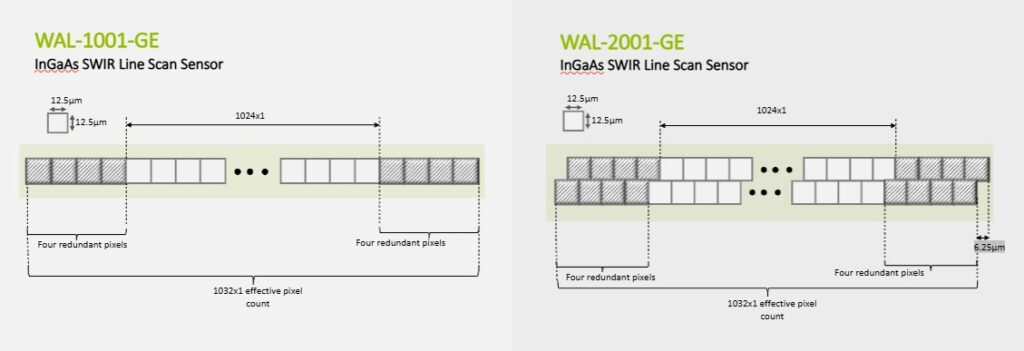
Sensor layouts on 1001 vs 2001 models:
How much resolution do you need?
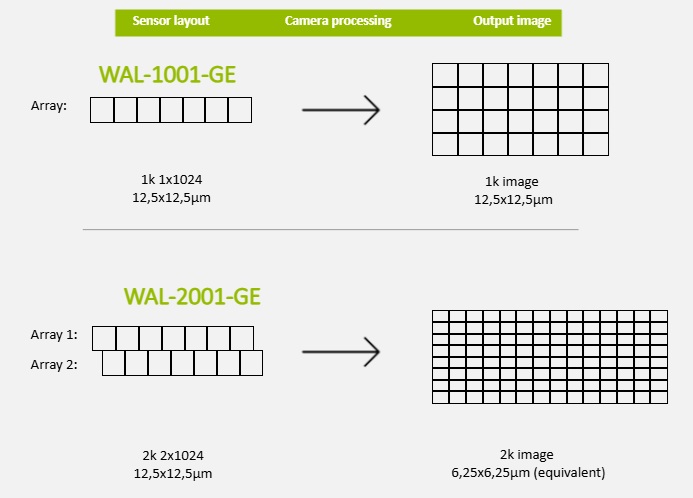
Key point: The 2k camera captures with both of the offset lines, this offset will reveal sub pixel details revealing smaller defects.
It will also oversample the sensor running at twice the normal speed to get the same level of detail in the movement direction. It will then output an image with the equivalent of a 2k sensor with half the pixel size.
Doubling down on the 2 row camera, for emphasis
While the 1k camera is already enough for many applications, let’s spend a moment longer on the 2 row WAL-2001-GE model. The biggest value proposition in this model is:
Doubled resolution for enhanced defect detection
A 0.5-pixel offset design effectively doubles sampling density, enabling reliable detection of sub-pixel-scale defects beyond the limits of conventional 1K cameras.
But it’s also worth noting:
Optimized cost-to-performance ratio
The dual-row 1K sensor configuration replaces a native 2K sensor, delivering high-resolution infrared imaging while reducing overall system cost.
…and
Internal image synthesis for simplified system design
The 2K image is synthesized in real time inside the camera, eliminating the need for an external acquisition card and reducing both system complexity and latency.
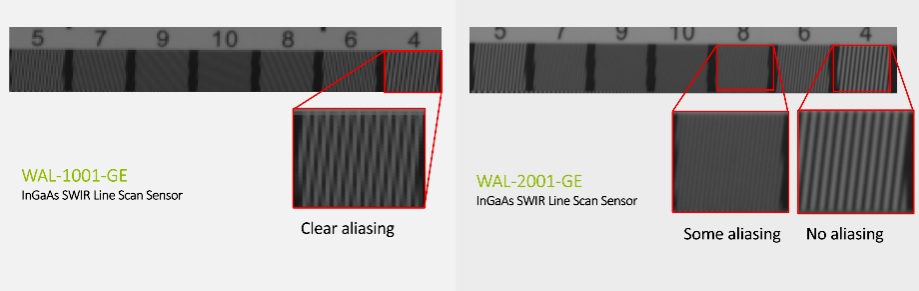
Resolution differences
Below, created under identical conditions, see the expected higher resolution with the 2k camera utilizing the 2 rows of pixels offset against each other.

1st Vision’s sales engineers have over 100 years of combined experience to assist in your camera and components selection. With a large portfolio of cameras, lenses, cables, NIC cards and industrial computers, we can provide a full vision solution!
About you: We want to hear from you! We’ve built our brand on our know-how and like to educate the marketplace on imaging technology topics… What would you like to hear about?… Drop a line to info@1stvision.com with what topics you’d like to know more about.
#JAI
#SWIR
#Linescan
#WAL-1001-GE
#WAL-2001-GE