245 MP SVS-Vistek SHR811 Super High Resolution Cameras

245 MP SHR811 – Courtesy SVS-Vistek

245 MP cameras in both monochrome and color models

SVS-Vistek, with 35 years experience developing machine vision cameras, releases their first SHR811 Super High Resolution cameras. Additional sensors and cameras will be released in the coming months. The first two SHR models, one each in monochrome and color, are based on the Sony IMX811 CMOS sensor.

Highlights at a glance (Left); LCD pixels (Right) – Courtesy SVS-Vistek

The right-hand image above may look like just a color grid – in fact it’s a segment of a 245 MP image from an LCD inspection application. So imagine a large HDTV or other flat panel showing a test pattern as part of post-production quality acceptance testing. The image is a segment of the inspection image showing just a subset grid of the activated pixels – at such resolution that machine vision algorithms can conclusively give each panel a clear pass or fail determination.

Frame rates to 12 fps might not sound impressive for certain applications, but for a 245 MP sensor, it’s pretty compelling. That’s achieved with the CoaXPress (CSP) interface.

For the SHR811 CCX12 COLOR camera
For the SHR811 MCX12 MONOCHROME camera

Applications and Examples

The series name – SHR – already suggests the applications for which these cameras are intended – Super High Resolution. You may have innovative applications of your own, but classical uses include:

  • Electronics and PCB inspection
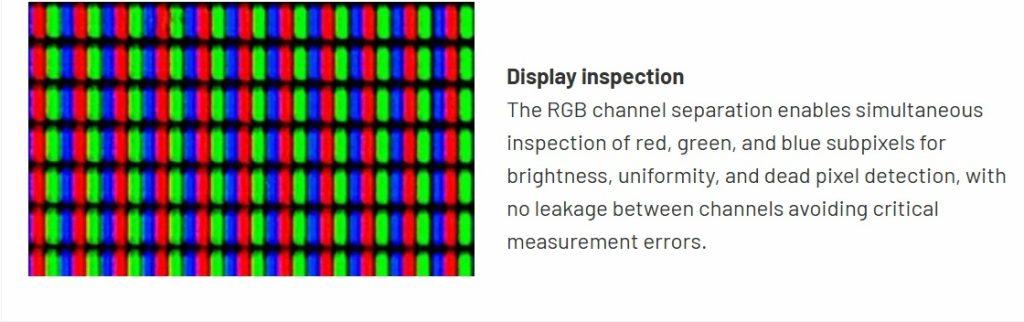
  • Display inspection
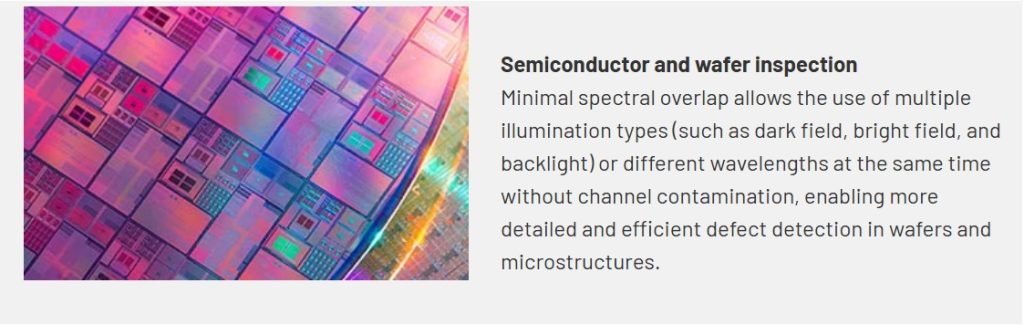
  • Semiconductor wafer inspection
  • Microscopy
  • High-end surveillance
Applications and examples – Courtesy SVS-Vistek

Additional applications include microscopy and surveillance:

SHR applications –
Courtesy SVS-Vistek

Technical details

Based on the Sony IMX411, this remarkable sensor is the key technology around which SVS-Vistek has designed the SHR811 launch-model camera.

This sensor has 62% higher pixel density than the highly-successful Sony IMX411 sensor, at 2x the framerate, and similar sensor size. So it’s a classic example of Moore’s Law, with size reduction and performance improvements, as Sony builds on its track record of innovation.

1stVision overview of the SHR811MCX12 monochrome camera

Features

As one would expect, there is a comprehensive feature set, including:

SHR feature overview – Courtesy SVS-Vistek

To highlight one specific feature, consider the Sequencer capability. It allows a single trigger to begin a series of timed exposures, as described in the following short video:

Setting the Sequencer – Courtesy SVS-Vistek

For full specifications, go to the SVS-Vistek SHR camera family, drill in to a specific model, and see or download PDF Datasheet, Manual, Technical Drawing, and/or Sensor Spec. Or just call us at 978-474-0044 and let us guide you.

1st Vision’s sales engineers have over 100 years of combined experience to assist in your camera and components selection.  With a large portfolio of cameraslensescablesNIC cards and industrial computers, we can provide a full vision solution!

About you: We want to hear from you!  We’ve built our brand on our know-how and like to educate the marketplace on imaging technology topics…  What would you like to hear about?… Drop a line to info@1stvision.com with what topics you’d like to know more about.

Allied Vision Goldeye SWIR 5GigE Pro – Coming soon

Goldeye Pro 5GigE SWIR camera – Courtesy Allied Vision – a TKH Vision brand

Coming soon – Goldeye Pro models with the TEC-version of Sony’s IMX992/993 SenSWIR sensors – tuned to 400nm – 1,700nm. We previously covered these sensors in Allied Vision’s compact uncooled Alvium cameras. Now Allied Vision brings these sensors to the Goldeye Pro lineup, with two important features: Thermoelectric cooling (TEC) and 5GigE interface.

1. Thermoelectric cooling (TEC)

Image quality is enhanced by thermoelectric cooling (TEC). Often paired with InGaAs sensors common in SWIR imaging cameras, Allied Vision now brings TEC to these CMOS Sony sensors. Why? Because cooling reduces thermal noise, creating a higher signal-to-noise ratio.

2. Fast 5GigE interface – framerates to 150fps

With the 5GigE interface, these SenSWIR cameras deliver frame rates above 100fps:

Courtesy Allied Vision – a TKH Vision brand
Visible vs. SWIR image pairs – Courtesy Allied Vision – a TKH Vision brand

But first, how about those SWIR images?

More about the new camera models in a moment, but first a reminder about SWIR. Short-wave infrared imaging enables machine vision applications beyond the visible portion of the spectrum.

Example applications

Per those striking image pairs at the top of the article, consider briefly:

  • Banknote validation: The SWIR application detects features unseen in the visible spectrum
  • Fluid fill levels: Able to see through even opaque plastic bottles, SWIR can monitor and control fill levels.
  • Materials detection: Whether for security or quality-control, many materials emit/reflect distinctly in the SWIR range, despite appearing identical under visible light.
  • Agriculture: Crop monitoring and irrigation applications are enabled by SWIR, which can detect moisture unseen by visible light. Fruit-sorting applications are also supported.

Back to the future

SWIR imaging isn’t new, but commercially it’s growing by leaps and bounds at present. Allied Vision has been an innovator and leader in SWIR for some time, and continues to expand their portfolio of SWIR cameras. While Allied Vision also offers SWIR capabilities in their compact Alvium models (with USB3, MIPI CSI-2, and GigE interfaces), their flagship SWIR offerings are found in the Goldeye product families.

The comprehensive Goldeye offering includes sensors that cover SWIR, XSWIR, and VSWIR portions of the spectrum. Some models are uncooled, while others provide cooling. You may know exactly what your application requires. Or you might appreciate our guidance.

Contact us

More about Goldeye Pro 5GigE cameras

Noteworthy features include:

On-board automatic image correction

Stabilized sensor cooling without a fan

Lockable cable connectors

Power over Ethernet (PoE)

Spectral sensitivity

Sony SenSWIR wide spectral sensitivity – Courtesy Allied Vision – a TKH Vision brand

For full details…

This article was intended as a short overview of the new Goldeye Pro SWIR 5GigE cameras. See all Allied Vision Goldeye SWIR cameras, and Alvium SWIR cameras, including datasheets and comprehensive attributes. There are many choices now in SWIR, VSWIR, and XSWIR imaging. Tell us more about your application and we’ll be happy to advise.

1st Vision’s sales engineers have over 100 years of combined experience to assist in your camera and components selection.  With a large portfolio of cameraslensescablesNIC cards and industrial computers, we can provide a full vision solution!

About you: We want to hear from you!  We’ve built our brand on our know-how and like to educate the marketplace on imaging technology topics…  What would you like to hear about?… Drop a line to info@1stvision.com with what topics you’d like to know more about.
IDS Imaging XCP-E Event-Based Cameras – and the Sony Prophesee IMX636 Sensor

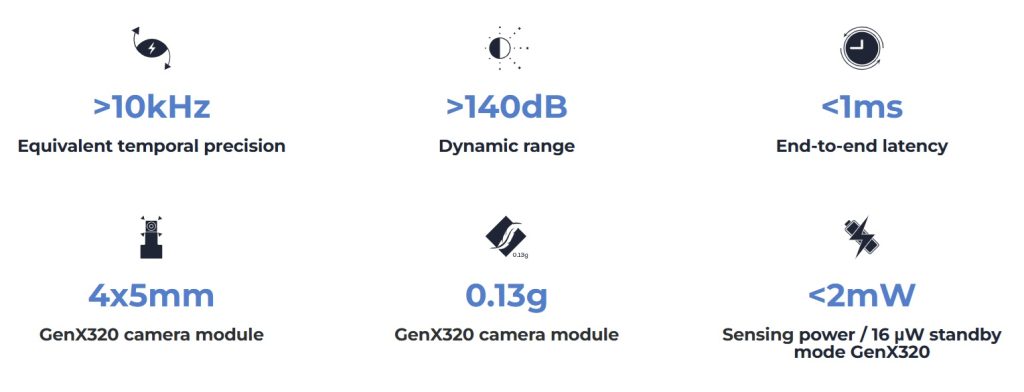
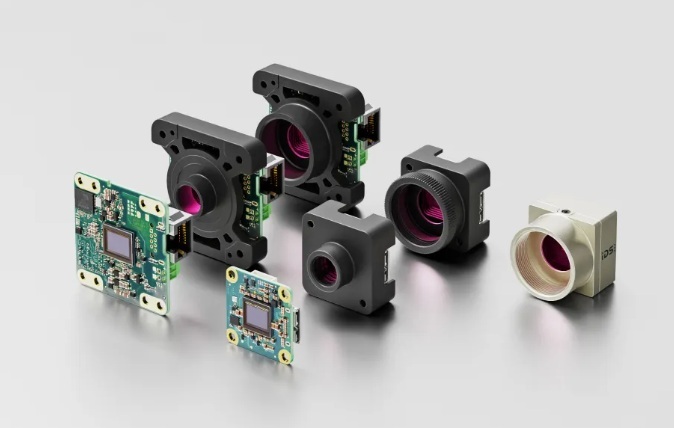
Recently we introduced the IDS Imaging event-based cameras, the uEye XCP-E models. These cameras are a paradigm shift – they detect changes in pixel brightness and transmit ONLY those changes. This dramatically reduces data load, lowers latency, and improves efficiency.

uEye XCP-E event based cameras – housed and board-level options – Courtesy IDS Imaging

Speed, speed, speed

Temporal resolution is better than 100μsec! Rapid changes can be detected – equivalent to an area scan camera operating at >10,000fps.

Paradigm shift – from “frames” to “events”

This is one of those aha moments. Too often we get jaded in believing that things only evolve incrementally – Moore’s law and electronics getting faster and less expensive, etc. Yawn. But this really is a game changer worth getting one’s head wrapped around.

Paradigm shift – an event-based sensor enables a new applications approach – Courtesy Sony / Prophesee

The event-based vision sensor (EVS) was developed by Sony and Prophesee.

Contact us to talk to an expert!

Industrial use cases

With a radically new technology, even machine vision veterans may appreciate seeing example applications already utilizing event-based imaging:

Some typical applications for event-based imaging – Courtesy Sony / Prophesee

Example applications

The following are meant to be suggestive rather than inclusive. Just to whet the appetite.

Courtesy Sony / Prophesee

Let’s enlarge that “alternatives” comparison from the above graphic:

Which level of complexity, performance outcomes, and costs do you prefer? Courtesy Sony / Prophesee

Another class of applications

Courtesy Sony / Prophesee
Vibration monitoring can alert the need for preventative maintenance – Courtesy Sony / Prophesee

Take the guesswork out of when to do preventative maintenance. Maximize uptime. Reduce the risks of catastrophic failure. These cameras are affordable enough to let them do the vibration monitoring – just set your alert threshold!

Let the sensor monitor vibration frequencies – Courtesy Sony / Prophesee

Software for event-based imaging applications

New paradigm best served by Metavision Technology Software – Courtesy Sony / Prophesee
Metavision SDK modules built for event-based imaging applications – Courtesy Sony / Prophesee

Get it? Got it? Need it? Want it?

This is a new way of coming at machine vision applications. It may give you an edge over your competition by enabling you to improve quality, reduce costs, and/or innovate new products or services. It really is different. See the IDS Imaging uEye XCP-E event-based cameras and datasheets. Powered by the Sony IMX636 developed in conjunction with Prophesee.

Tell us more about your application, using the link below. Or just call us at 978-571-5552. We can help you determine whether event-based imaging is optimal for your application.

1st Vision’s sales engineers have over 100 years of combined experience to assist in your camera and components selection.  With a large portfolio of cameraslensescablesNIC cards and industrial computers, we can provide a full vision solution!

About you: We want to hear from you!  We’ve built our brand on our know-how and like to educate the marketplace on imaging technology topics…  What would you like to hear about?… Drop a line to info@1stvision.com with what topics you’d like to know more about.
Six new JAI line scan cameras across two product families

JAI has over 60 years experience in the vision industry, and is likewise a longstanding part of the 1stVision portfolio. JAI produces a diverse range of cameras, including area scan and line scan; across multiple interfaces; and spanning visible, NIR, SWIR, and UV portions of the spectrum.

In this article we announce six new line scan camera models: 4 in the Sweep series at 4k each; and 2 in the Sweep+ series at 4k and 8k respectively. There’s a niche for every model.

Four new 4k line scan cameras – Courtesy JAI Imaging
Two new Sweep+ line scan cameras – one 4k one 8k – Courtesy JAI Imaging

Four new 4k line scan Sweep models; Two new Sweep+ models incl. 8k

At the risk of information overload, we’ve bundled this product release update of six new camera models across two product families into a single article. We hope the reader appreciates the compare-and-contrast approach as a way to understand the value proposition for each camera/family.

When you need line scan it’s nice to have options

While area scan sensors with big 2D pixel array outputs are right for some applications, line scan is a better fit for others. In particular, if the object being imaged is essentially continuous, line scan can be an effective way to take narrow image slices with a lower cost 1D sensor that’s long in just the dimension that maps to the object width. Movement of the object (or sensor) together with successive slices then creates the second dimension.

The 1stVision Knowledge Base offers illustrated articles on line scan topics, including How to Calculate Line Rate Based on Conveyor Speed and Polarization Techniques with Line Scan Cameras. Now on to the new camera models!

Example line scan applications – Courtesy JAI Imaging

JAI’s Sweep line scan cameras vs. Sweep+

JAI’s Sweep line scan cameras include a wide offering of monochrome, bilinear, and trilinear models, at 2K, 4K, 8K, and 16K. Interface options include 5GigE, 10GigE and CoaXPress. If you need color sensing, the bilinear approach is an affordable approach, and often plenty good enough. For true color capture, the trilinear sensors are superior – if needed.

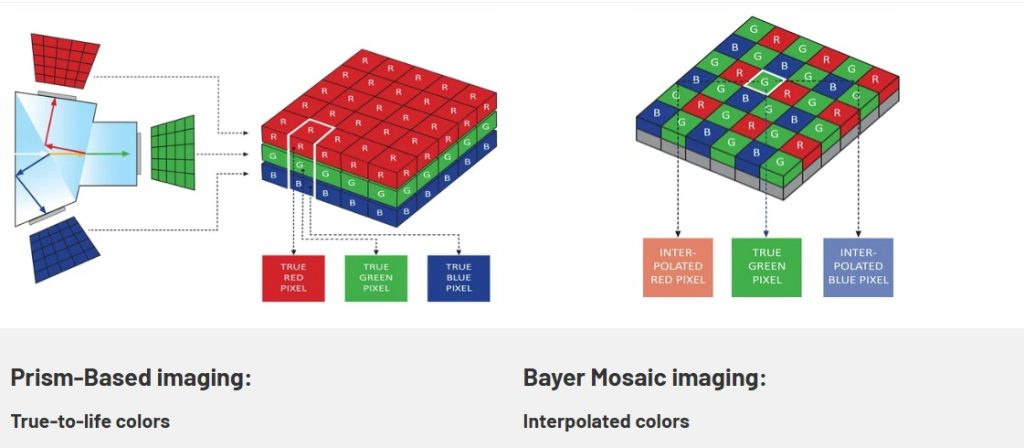
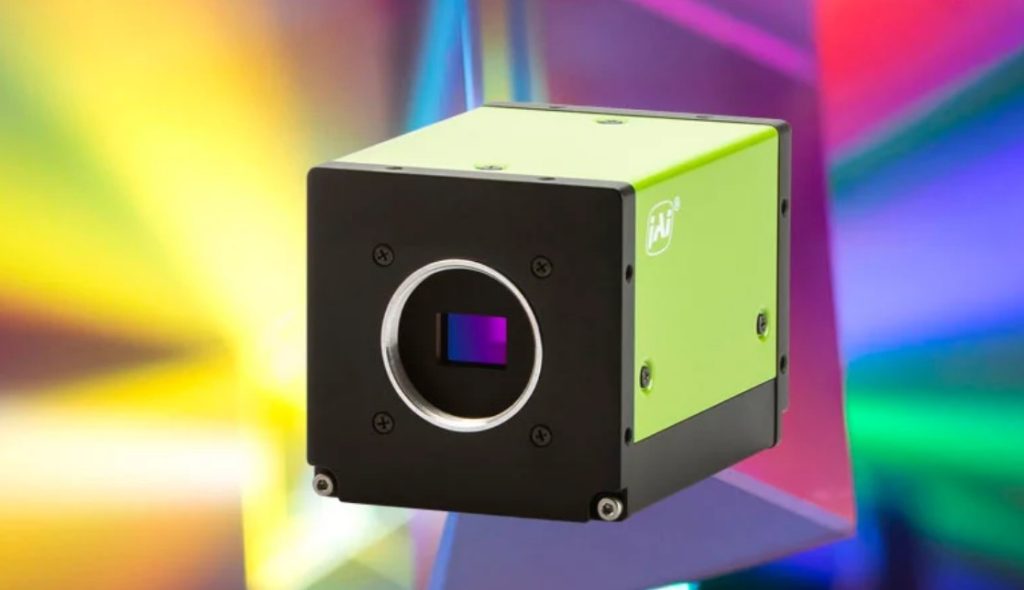
Sweep+ cameras, as suggested by the + suffix, are JAI’s top of the line color and multispectral line scan products. The beam-splitter prism optics, together with three (color only models) or four (color plus NIR) sensors, deliver high-precision color resolution. Due to the data volumes generated, the Sweep+ cameras use CoaXPress, 10GigE, and CameraLink interfaces to achieve line rates suitable to the respective sensor sizes and anticipated applications.

Click to contact
Give us some brief idea of your application and we will contact you to discuss camera options.

Mini-tutorial on single sensor vs. multi-sensor color imagin

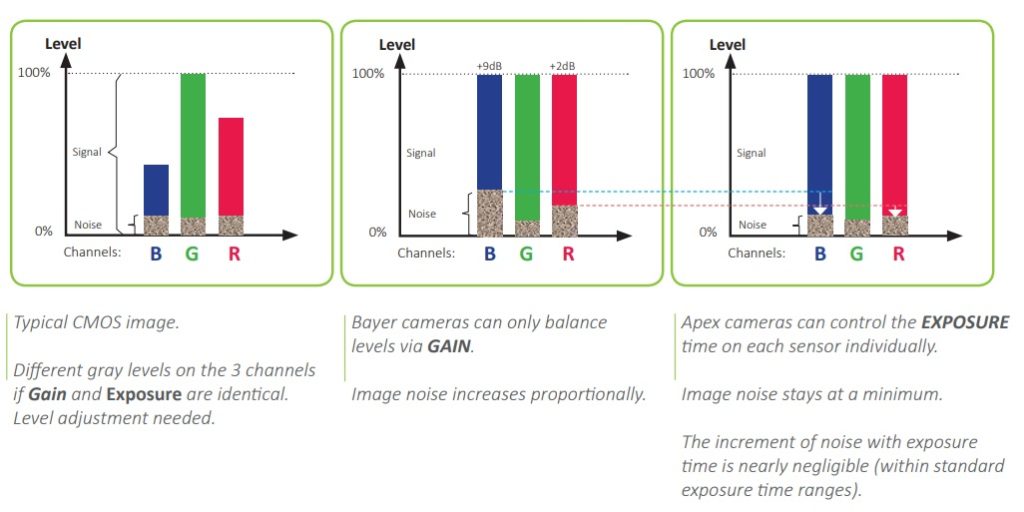
While Bayer filters or equivalent provide single sensor color, that’s good enough for some applications, there is some loss of color resolution via that inherent physical interpolation. So demanding applications take advantage of separate sensors for each segment of the spectrum, using a prism to separate wavelengths. The resulting camera is physically larger to accommodate the the prism, extra sensors, and electronics – but the best possible color performance is achieved.


A deeper dive on the new Sweep cameras

At-a-glance overview of the Sweep 4k cameras – Courtesy JAI Imaging

Monochrome line rates are 2x that of the bilinear color models

… because there is a single monochrome pixel mapped to the target object’s corresponding area.

Courtesy JAI Imagine

But if you need color the bilinear approach is an efficient way to do it, since there are only two rows of data transmitted for every real-space row imaged….

A peak at the bilinear approach to color line scan imaging

Courtesy JAI Imaging

Other JAI Sweep camera features

Keystone correction, aka tilted view correction, onboard the camera

Trigger-width dynamic exposure control

Resume-scanning control for stop-start motion

Trigger delay

… and more

Drill in to JAI Sweep camera models and datasheets. Or let us guide you.


More details on JAI’s new Sweep+ line scan cameras:

A 4k and and 8k model, both with CoaXPress interfaces – Courtesy JAI Imaging
The two new models round out the Sweep+ lineup – Courtesy JAI Imaging
Precise prism optical design yields superior images – Courtesy JAI Imaging
Some of the key benefits of CoaXPress – Courtesy JAI Imaging

And yet more features…

You get the idea… Sweep+ is a remarkable camera family. There are even more features to find in the Sweep+ product details and datasheets. Or just call us at 878-571-5683 for expert assistance. Tell us about your application requirements and we’ll guide you to an optimal camera. Lighting, lenses, filters, cables, and software too.

1st Vision’s sales engineers have over 100 years of combined experience to assist in your camera and components selection.  With a large portfolio of cameraslensescablesNIC cards and industrial computers, we can provide a full vision solution!

About you: We want to hear from you!  We’ve built our brand on our know-how and like to educate the marketplace on imaging technology topics…  What would you like to hear about?… Drop a line to info@1stvision.com with what topics you’d like to know more about.