HDR (high dynamic range) images expand the dynamic range of an image and make details visible in very bright or very dark areas. HDR images are therefore particularly suitable for industrial image processing applications where high contrast or changing light conditions make reliable object recognition and image analysis difficult.
Sequencer HDR
With Sequencer HDR, multiple images with different exposures are taken in sequence. You can configure the number of images (2 ... 10) and the exposure times flexibly. The single images are combined in IDS peak to create an HDR image with extended dynamic range. The quality of the HDR image depends on the number of images and the selected exposure times of each image. The closer the exposure times of the single images are to one another, the smaller the drop in the SNR (signal-to-noise ratio) in the transition areas between two exposure levels. The more images are captured with different exposure times, the higher the SNR can be in these transition areas and/or the greater the dynamic range can be expanded.
Since the single images are captured at different times, motion artifacts may occur. This method enables HDR images to be created even with cameras without special HDR sensor features.
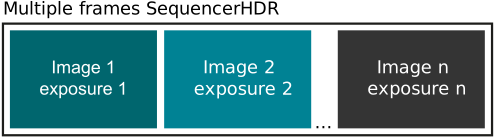
Fig. 80: Image acquisition in Sequencer HDR
|
When creating your own applications with the HDR Sequencer, you must ensure that the images in the sequence are received in the correct order. If images are discarded due to buffer overflows or long processing times, the mapping between images and exposure times may be incorrect, resulting in an incorrectly computed HDR image. Note the following items: •Check the completeness of the sequence by detecting and handling frame losses (e.g., via NumUnderruns or DataStream > StreamLostFrameCount). •Use chunks to attach metadata such as exposure time (ChunkExposureTime) and/or sequence set index (ChunkSequencerSetActive) to the images. |

Clear HDR
Clear HDR extends the dynamic range within a single frame. To do this, each pixel is read twice, once with low gain (“AnalogLow”) and once with high gain (“AnalogHigh”). This allows bright and dark areas of the image to be captured simultaneously. The image data generated in this way is combined into an HDR image in IDS peak. As no time-shifted frames are combined, but both images are exposed line by line, there is only an offset of one line between the two image data. Therefore, motion artifacts occur only to a limited extent. However, the expansion of the dynamic range is limited.
The resolution of the HDR image corresponds to the full sensor resolution. Because twice as much data is read and transmitted, the line speed is slower, which reduces the maximum frame rate and increases the rolling shutter effect. This must be taken into account in the application.
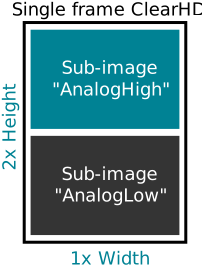
Fig. 81: Frame in Clear HDR mode
Quad HDR
With Quad HDR, the four pixels in a 2×2 pixel area (similar to the Bayer pattern) are exposed with different exposure times. In the quad HDR, the exposure times end at the same time.The start of each exposure time depends on the duration set in each case. Then, the image is transmitted with the respective data and processed in IDS peak to create an HDR image. Depending on the selected exposure time per pixel, up to 4 different exposure times can be selected to improve dynamic range or SNR (signal-to-noise ratio). Longer exposure times should be avoided in terms of image quality.
Because all exposures end at the same time and are captured within a single global frame, no temporal artifacts occur during HDR processing. Motion artifacts are practically avoided. Quad HDR is implemented using global shutter sensors, so there is no rolling shutter effect. However, the resolution of the HDR image is only a quarter of the sensor resolution.
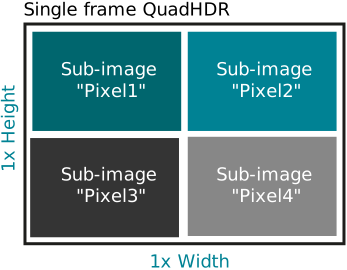
Fig. 82: Frame in Quad HDR mode
Comparison of HDR modes
|
Sequencer HDR |
Clear HDR |
Quad HDR |
|---|---|---|---|
Acquisition principle |
Multiple images in sequence |
One image, two gain levels per pixel |
One image, up to four exposure times per 2×2 pixel area |
Resolution |
Full resolution |
Full resolution |
1/4 of the sensor resolution |
Timing |
Time-separated acquisition |
Simultaneous acquisition |
Simultaneous acquisition |
Dynamic range |
Very high, flexible configurable |
Moderately increased |
High |
Image artifacts |
Possible |
Very low |
Minimum possible, e.g. on edges or along the movement direction |
Frame rate |
Depending on the number and duration of exposures |
Reduced |
High |
Suitable for |
•Static scenes •Very slow scenes with a correspondingly fast camera |
•Static scenes •Scenes with little movement |
•Moving scenes |
Availability |
uEye+ cameras which support sequencer |
•U3-34Ex •U3-34Fx •U3-34Jx •U3-34Lx •U3-38Cx •GV-54Ex •GV-54Fx •GV-54Jx •GV-54Lx •GV-58Cx |
•U3-33Dx mono •GV-53Dx mono |
Additional information
Camera feature reference |
|
|---|---|
IDS peak topics |
•Guides in IDS peak ICV: High dynamic range •Concepts in IDS peak ICV: Pixel and pixel format specifications |
Code examples |
•C++: hdr / hdr_from_file •Python: hdr / hdr_from_file •C#: HDRFromFile |